Watch message
Chained to What’s Behind You

Share message
Link Copied
Key Scripture
You planned evil against me; God planned it for good to bring about the present result — the survival of many people. —Genesis 50:20
Discussion Questions
Message Highlights
- Forgiveness isn’t denying the hurt—it’s refusing to live controlled by it.
- You may never get the apology, the explanation, or the closure. But you can still get freedom.
- Forgiveness begins when you step out of God’s seat. Justice and vengeance belong to Him, not to you.
Conversation Starter
When you were growing up, what did your family teach you about forgiveness—through what they said or through how conflict actually got handled? What did that shape in you?
Core Discussion Questions
Connection Question What stood out to you from this week’s message about what forgiveness actually is and isn’t?
Context Question Where have you encountered the idea of forgiveness before—in church, in your family, in stories or culture? What did you previously believe forgiveness required of you?
Clarity Question This week’s message said forgiveness isn’t denying the hurt—it’s refusing to be controlled by it. How does that distinction change what forgiveness might look like in your own life?
Application Question Is there someone—or something—you’ve been waiting for an apology from that you might need to release this week? What would it look like to step out of God’s seat with that situation?
Additional Questions
- Joseph said, “You planned evil against me; God planned it for good” (Genesis 50:20, CSB). How do you hold the reality of evil and the sovereignty of God together when you’re in the middle of pain?
- What’s the difference between forgiving someone and trusting them again? How does wisdom guide that distinction?
- Where in your own story have you seen God redeem something that started as harm?
Transcript
This is the last part of our series called “Forward.” So I wanna start with the question. Have you ever held a grudge? I know none of you have ever held a grudge. You’re good spiritual people. You would never hold a grudge.
But I held a grudge. Oh, I held a grudge and I held a grudge for nine years.
I was at a youth conference and forget what I was doing there, but a friend of mine thought he would be funny. Now you have to understand, we were those kinds of friends that we just did awful things to each other and we thought it was hilarious. We would trip each other going down or up the steps and would laugh at one another. If somebody was holding something, we would push them over. We would get behind the other person and let somebody else push him over top of this. I mean, we just did awful things to each other. It’s what friends are for.
And so we’re at a youth conference and this was way back a long time ago when it was cool to have like a long, like little tiny rip in your jeans. Not like a big rip, just a rip big enough to be like, I’m cool, but I still have it together.
And so he said to me, he’s like, hey, look at that thing over there. And I looked at that thing over there and he put his finger in the rip and ripped my jeans all the way down my leg.
And I didn’t have a change of jeans. And so for the rest of the day, I walked around with this big rip in my pants nine years later. I looked at him and I was like, bro, I’m gonna remember this and I’m gonna get you back. Nine years later, he and I were in Israel together. We’re at Masada, it’s really warm and hot. I just hiked all the way up. Oh man, I forget the name. Actually, I hiked all the way up the hill at Masada. Hiked all the way up, it was warm and sticky. And we’re getting ready to get on the bus and he was in front of me. And I was gonna grab his foot when he went to go step on the bus so that he’d fall flat on his face. Say, how old were you? Like 39.
And I was gonna be like, ha, nine years later, gotcha. And just as he was walking up the bus, I saw the backside of his shorts. And right near the pocket was this little tiny hole.
And I said, I got a better idea. And so I stuck my finger in that little hole and I ripped.
And I didn’t know my own strength.
And I ripped so bad that the rest of the day he had to hold his shorts together. As we’re walking through Israel, you say, well, you were in Israel, you were supposed to be spiritual. Listen, I held a grudge for nine years. I’m not that spiritual, okay? Now, you might think this is really awful, okay?
But to make the story even better, my friend, when he was a little kid, he had a pipe fall on his arm and lost his arm when he was four years old. And so when I ripped his shorts, there wasn’t another arm for him to hold on to the shorts with. And so for the rest of the day, he was like, I need you to, like, can you give me a sip of my water? He’s like, or can you just hold my shorts? I’m like, bro, I’m not holding your shorts. Like, that’s just weird. So for the rest of the day, I’m like trying to give him a sip of water. And I’m like, oops. And I spill it down the front of him. I mean, I took that for everything it was worth.
So we hear stories like that and we go like, yeah, that’s funny, you guys were friends, but you know what, it’s easy. It’s easy for us to be offended and to hold a grudge.
It’s easy for us to get bothered by someone, to get hurt by someone and to hold a grudge.
And let’s be fair, someone may have hurt you, said something to you, did something to you, and it’s a very valid thing that they did wrong. And it’s hard for you not to hold that grudge, to get bitter, to get angry and to stay that way. We’re going back over the life of Joseph. I’m gonna do this review quick this morning, just in case you weren’t here. Maybe it’s your first time, maybe you’re not familiar with the life of Joseph. But even if you are, listen carefully, because if you’re not careful, you’re gonna assume that you already know what’s going on. Tune out and miss what God has for you today. Because today isn’t how Joseph’s story ended. It’s about what God was doing in his life. What God was doing in Joseph, while his entire life was unfolding. If you remember, Joseph was loved by his father, hated by his brothers, favored by God. Joseph has two dreams, that his brothers and his family would bow down before him, that he would lead them. Joseph’s misunderstood, hated by his brothers, sold into slavery, sold to a man named Potiphar. While he’s working for Potiphar, God blesses him. And everything that Joseph does is blessed.
Potiphar’s wife wants to sleep with Joseph, and Joseph says, “How could I do this immense evil “and sin against God?” She falsely accuses him of attacking her. He’s then thrown into prison, and while he’s in prison, God blesses him again.
And Pharaoh is angry with his cupbearer and his baker, so he casts them into prison. While they’re there, they dream dreams. Joseph interprets those dreams. Three days the cupbearer will be back where he belongs. Three days the baker will be put to death. Joseph pleads with the cupbearer, “Don’t forget me. “Remember me, tell Pharaoh I haven’t done anything wrong.”
The cupbearer forgets Joseph for two years until Pharaoh has a dream. And when Pharaoh has a dream, all of a sudden he remembers this guy in prison who interpreted the dreams, and he tells Pharaoh, Pharaoh brings Joseph before him. Joseph tells Pharaoh his dream and interprets Pharaoh’s dream.
Seven years of great abundance are coming, and then after them seven years of famine will take place. Joseph’s elevated into the second-in-command of all Egypt. He prepares the nation during the years of abundance so that they have food, and the Bible says this, “When the famine hit, that it hit every land.”
Joseph’s brothers find out that Egypt has food that they’re selling it for a profit. They travel all the way there to get food. They bow down in front of the second in command of all of Egypt, not realizing that it was Joseph.
And this, this is where our message picks up right from this point. Genesis chapter number 45, verse number one says this, “Joseph could no longer keep his composure “in front of all his attendants, so he called out, “send everyone away from me. “No one was with him when he revealed his identity “to his brothers, but he wept so loudly “that the Egyptians heard it, “and also Pharaoh’s household heard it. “Joseph said to his brothers, “’I am Joseph, is my father still living?'” Watch this, “But they could not answer him “because they were terrified in his presence.” You say, “Why, why were they terrified?” Because Joseph had authority. Joseph had influence. Joseph had power. And they’re standing in front of his presence, and he had every right, humanly speaking, to retaliate, to put them in prison, to make them pay for everything that he had gone through.
But look at verse number four. “Then Joseph said to his brothers, “’Please come near me.' “And they came near.
“’I am Joseph, your brother,' he said, “the one you sold into Egypt.
“And now don’t be grieved or angry with yourselves “for selling me here, “because God sent me ahead of you “to preserve life.” I mean, let that sink in for just a minute. These are the same brothers that hated him. These are the same brothers, the Bible says this phrase, they couldn’t speak peaceably to him. They stripped him of the robe of the tunic that his father had given him. They threw him in a pit, they had planned to kill him, but instead of killing him, mercy was selling him into slavery.
They lied to their father and said some wild beast killed him.
And here’s what’s interesting, Joseph doesn’t say, “Hey, I forgive you.” He says, “Don’t be grieved or angry with yourselves.”
He doesn’t jump right out and say the statement, “I forgive you,” and we’re gonna get to that in a minute, and it’s because he’s already forgiven them.
He says, “Don’t be angry with yourselves. “Don’t be grieved with yourselves.” I’m gonna be honest with you, this is a level of forgiveness that I have a really hard time understanding. Because I understand I forgive you for what you did. But this verse is showing that Joseph, Joseph is at peace with forgiving his brothers by saying, “Don’t be grieved or angry with yourselves.” Wanna be honest with you, if I’m Joseph, I kinda want him to be angry with themselves.
Oh, don’t look at me so pious. Someone sold you into slavery and pretended like you were dead, and like they’re all of a sudden before you and you have the power, come on, you’re gonna want them to be a little angry with themselves. You’re gonna want them to be a little grieved. You’re gonna want them to feel bad because what they did was bad.
And the reason I know this is because we struggle with offenses that pale in comparison to the life of Joseph, and we can’t forgive. We stay bitter. We wanna hold on to some grudge because of something that someone did to us years ago, and if we’re honest, and we actually try and recount the story and we talk about what they did, we forget so many of the details.
Joseph says, “Don’t be grieved. Don’t be angry.”
Like I said, if I’m Joseph, I want him to be a little hard on themselves, but Joseph, Joseph was at peace. I want you to catch this statement, not because the pain wasn’t real, but because God had given him perspective. So how do you know God gave him perspective? How do you know he came to a place where he forgave already? Because years earlier, Joseph has sons, and he names his sons, and he names the first born Manasseh, the Bible says. And the name Manasseh means, “God has made me forget all my hardship and my whole family.” He names the second son Ephraim. The meaning of Ephraim is, “God has made me fruitful in the land of my affliction.” Here’s Joseph. Okay, God, you’ve allowed me to forget all my hardship. You’ve allowed me to forget what my family did to me.
All right, Lord, I’m starting to see it all fit together now.
Okay, God, you’re allowing me to do something. You’re making me fruitful in this place that I thought was my torment, was my torture, that I thought was going to break me, was going to kill me.
And I want you to hear me clearly, Joseph doesn’t forget the events. Here’s what he does. He releases the control the pain had over him. Long before his brothers bowed down before him, we see Joseph’s heart of forgiveness.
See what Joseph learned is he learned to see fruit, to see peace, to see goodness, where many people only see affliction. I want you to see the statement it’s going to be on the screen. We’ve got to discipline ourselves to see God’s work in our lives because affliction has a way of blinding us. This happens. Come on, we get our small offense that feels great to us. And somebody comes over and say, hey, how are you doing today? And all we can say is, oh, it’s awful. My life has never been this bad. It’s never been this hard. Come on, everybody in this room, we’re in the top 1% of the world financially, physically with our health. God has blessed us. We have the freedom to come and to worship the Lord, to hear his word opened up and preached to us without fear of any repercussion.
And all too often what happens to us is difficulty enters our lives and we lack the discipline to see God’s work in our lives because all we see is affliction and we allow that affliction to blind us.
Genesis 45 verse seven says this, Joseph is speaking, God sent me ahead of you to establish you as a remnant within the land to keep you alive by a great deliverance. Therefore, it was not you who sent me here, but God. Did you catch that maturity right there? Did you get that perspective from Joseph? Hey, yeah, you were the ones that hated me. You were the ones that beat me. You were the ones that threw me in the pit. You were the ones that sold me into slavery, but I’m gonna tell you, you didn’t send me here. God sent me here. Look at the rest of the verse. He has made me a father to Pharaoh, Lord of his entire household and ruler over all the land of Egypt.
Now I want you to get this, Joseph isn’t minimizing their sin. Joseph isn’t letting them get away with their sin. Joseph isn’t saying, hey, what you did to me, it wasn’t wrong, it’s good, it’s okay. Joseph’s not saying that what they did was right.
He wasn’t minimizing their sin. What he is doing is magnifying God’s sovereignty. And you thought you were doing something, but God was in control all along. But the story isn’t over. Genesis 45 verse nine, here’s what he says, “Return quickly to my father and say to him, this is what your son Joseph says. God has made me Lord over all of Egypt, come down to me without delay.” Joseph’s father and brothers, they pack up everything, they move to Egypt. And for years, Joseph cares for them.
Joseph shows his brothers kindness.
Joseph loves his family, puts them in the place where they are cared for, they’re accepted.
But here’s where our message takes a little bit of a turn. But after Jacob, Joseph’s father, after Jacob dies, everything changes. Genesis 50 verse number 15, “When Joseph’s brothers saw that their father was dead, they said to one another, if Joseph is holding a grudge against us, he will certainly repay us for all the suffering we caused him.” Hey, if Joseph, if Joseph’s holding a grudge, this is where he takes revenge. Maybe this whole time he was just being kind and doing kind things for us and caring for us just because our father was alive. Hey, his brothers, Joseph’s brothers, they’re assuming that forgiveness was temporary. They assume that Joseph was holding some kind of a grudge, that kindness, that forgiveness were just conditional. Look at verse number 16. “So they sent this message to Joseph, before he died, your father gave a command.
Say to Joseph, please forgive your brothers transgression and their sin.” The suffering they caused you, therefore, please forgive the transgression of the servants of the God of your father.
Joseph wept when their message came to him.
See his brothers were in this habit of doing wrong and lying to cover it up. Oh, we hate our brother, we’re gonna kill our brother. No, we’re not gonna kill our brother, we’re gonna sell him to slavery. They take Joseph’s coat, the one that his father gave him, they drench it in blood and they say, hey, we found it. Some wild beast must have killed him.
And now when it’s just them and Joseph, they decide to lie again. And Joseph, when he hears it, he weeps.
Verse 18, his brothers also came to him, bowed down before him and said, we are your slaves.
And what Joseph says next, the words that he says reveal his heart, words, words that I’m gonna be honest, convict me, words that ought to convict you and ought to teach us something about forgiveness.
Because all too often what we do is we think about how much people have hurt us, what people have said about us, how they’ve treated us, what they’ve done. And we lock ourselves into this place of holding a grudge and holding bitterness and not being able to go forward in life.
And we get trapped by the pain of our past. But what Joseph says is everything. Verse number 19, but Joseph said to them, don’t be afraid, am I in the place of God?
Joseph is saying this, listen, I’m not the judge. I’m not the avenger. I’m not God, hey, what you did, what you did, you didn’t really do to me. I mean, you did it to me, but ultimately sin, sin is against almighty God first.
Hey guys, you think you did me wrong and that I’m just gonna come after you, but you don’t understand, I’ve learned something. And he says it all the way back when Potiphar’s wife wants to seduce Joseph and he says, how can I do this immense evil and sin against God, not sin against Potiphar?
Sin against God. He learned something, he said, oh wait a minute, sin, sin is against almighty God himself. Hey guys, why are you worried about me? Guys, I’m not the judge. I’m not the avenger, I’m not God. Listen, what you did, you did wrong, but you didn’t do it to me. You did it to almighty God.
And how much peace would we have in our lives?
How much hope could we see? Think about how we could move forward. If we got to the place where we looked people in the eye or on our knees in prayer and we said, I’m not gonna hold this grudge, I’m not gonna hold this bitterness, because ultimately what they did, it’s against God. Look at what Joseph says next. He says, you planned evil against me. God planned it for good to bring about the present result, the survival of many people. Hey Joseph, Joseph trusted God enough to release the right to get even. To look at people who had hurt him and say, you don’t owe me anything.
That sounds really powerful when it’s Joseph’s life. And it sounds really powerful when we read it in scripture. But I know this about you and I know this about me. It hits different when it’s our story.
It hits different when it’s our story because it’s personal. I mean, we’re the one that felt the cut that was deep. We’re the one that felt the betrayal. We’re the one that felt the disappointment and the hurt.
We’re the one that perhaps absorbed the abuse that still haunts you today.
We’re the one with the emotions that we still carry because of what was done. We read a verse like this and we go, no, no, I can’t do that, I can’t do that because I’m still feeling what I’m feeling, I can’t let go.
And if we’re honest, part of us still feels like we’re owed something, some kind of an apology, some explanation, justice, that eye for an eye thing, people that don’t even know the Bible can quote that verse, just something. And when we read Joseph’s story, we admire it.
But a lot of times that’s where it stops and we don’t live it. Hey, what if we trusted God enough to release our right to get even? Hey, imagine the freedom, the freedom in your life if you let go of the anger, if you ended all the bitterness, if you stopped rehearsing the events that hurt you in your mind over and over and over again, if you stopped holding onto it, if you stopped carrying it, if it stopped becoming part of your identity, because this whole series has been about moving forward. You’re gonna see this on the screen. You cannot move forward while you’re still chained to what’s behind you. And so many people, they’re not moving forward because they’re chained to something that’s behind them. The bitterness, the grudges, the lack of forgiveness, I’m telling you, it’ll all keep you in prison. And at one point in Joseph’s life, he was physically in prison, but he wasn’t in the prison of his own bitterness, of his own anger, of his own resentment.
And this is what keeps people trapped. This is what keeps people right where they are. This is what keeps people right where they are because they say this statement, but they don’t deserve forgiveness. They don’t deserve forgiveness. If I forgive them, it’s like they get away with everything. Let me tell you, forgiveness has never been about somebody earning it. Forgiveness is about you trusting God with your pain. Let me say it again. Forgiveness isn’t about someone earning it. Forgiveness is about you trusting God with your pain. Forgiveness is for you.
Forgiveness is for me.
And you may find yourself, there may be some people in the room, everyone needs to forgive, hear me, everyone needs to forgive. Forgiveness is between you and God. Restoration takes you, God, and the other person. You might be at a place in the person that may hurt you. They may have done some things to you where you can’t let them back into your life. We still have to forgive. We still have to trust God with that pain. It doesn’t mean that we necessarily let them back into our life because restoration takes them, God, and you. But forgiveness, forgiveness is for you. Whole series is about moving forward. So if you and I, if we wanna move forward like Joseph, here’s what we need to do. Forgiveness begins when you step out of God’s place.
As long as we play the judge, as long as we play the one who avenges, forgiveness will feel impossible. Forgiveness always starts when we step out of God’s place and say, “I don’t have the right “to avenge. “I don’t have the right to get back. “I don’t have the right to get even. “I’m going to trust God with my pain.” And Joseph understood something. Joseph understood what we often miss, that justice belongs to God, that vengeance belongs to God, that making things right isn’t our responsibility. It’s his. And forgiveness is not saying that what the person did to you is okay. Forgiveness is saying this, “I trust God more than I trust my right to get even.” Forgiveness is trusting God more than you wanna retaliate. The other thing we gotta do, forgiveness, it doesn’t deny the hurt. Forgiveness doesn’t deny the hurt. Listen, it redefines it. Joseph didn’t minimize what happened. He plainly said, “You guys planned evil against me.” What you did was wrong. What you did was evil. He doesn’t rewrite history. He doesn’t spiritualize the abuse. He doesn’t say, “Well, you know, “you really didn’t do anything all that bad.” He didn’t pretend that the pain wasn’t real. Here’s what he did. He refused to be controlled by it. Forgiveness isn’t pretending that you weren’t hurt. Because I’m gonna be honest, you may be carrying more hurt than I can imagine. I guarantee you, there are people in this room who are walking through pain that I have never walked through. Walking through hurt that I couldn’t imagine. Your story might be so awful that I can’t even wrap my mind around it. But the word of God is true in forgiveness. Forgiveness is not saying that your pain isn’t real. Forgiveness, forgiveness is choosing not to be controlled by it. Joseph names the evil, but he refuses to live in it. I want you to see this on the screen. Hey, you can’t heal what you won’t acknowledge, and you cannot forgive what you refuse to face. I’ll say it again. You can’t heal what you won’t acknowledge, and you cannot forgive what you refuse to face. Let me say it like this. You can face your pain without being imprisoned by it.
So many times we tell ourselves, but I’m hurt. I’m hurt so I can’t let go, I can’t forgive. I’m not telling you your pain isn’t real. What I am telling you is you can’t let it control you. You can’t let it control you. You can’t be imprisoned by it. And when we do what God says, he redefines the hurt. He redefines the hurt. He redefines the pain. He redefines everything. Here’s what else we need to do. We need to realize that forgiveness grows when we trust God’s sovereignty.
Joseph says something remarkable. He says, “You planned evil against me. “God planned it for good.” Notice what he doesn’t say. He doesn’t say, “Hey, what you did wasn’t that bad. “It really doesn’t matter. “It’s okay. “It didn’t really hurt.” He says, “Hey, you’re responsible for evil, “but God was responsible for the outcome.” Hear me, God isn’t the author of evil. God isn’t the author of evil, but God was greater than the evil. And this is the heart of biblical forgiveness. Forgiveness grows when we trust God that God can redeem what others try to destroy.
Hey, you’re struggling to forgive? It may be that your view of God, that your view of God and his work in your life needs to grow, that you need to see him differently. Hey, some of you are carrying things that just feel unforgivable, betrayal, abandonment, lies, abuse, wounds that still ache to this day. And you try and reconcile carrying that into your life and then still trying to forgive at the same time. Hey, let me be clear. Forgiveness is not saying it didn’t matter. Forgiveness is saying God matters more.
And you may never get an apology. You may never get closure. You may never get answers. I’m gonna say that again. You may never get an apology. You may never get closure to your story. You may never get answers. But here’s what you can get that Almighty God wants to give you. He wants to give you freedom. Freedom is available, but we’ve got to forgive. Hey, Joseph saw God at work through the actions of others who intended harm.
And if God is sovereign, if he’s in control, then bitterness is unnecessary. God doesn’t waste pain. He redeems it. And I know Joseph’s story makes sense in the end, but forgiveness happened because God, God was at work in Joseph’s life and Joseph trusted God long before the end of his story. He trusted God. Hear me. He trusted God in the middle. And he forgave God. And he forgives in the middle, not at the end. Just kind of to wrap up the whole series from each message. We learned from the first one to let God lead you through your circumstances.
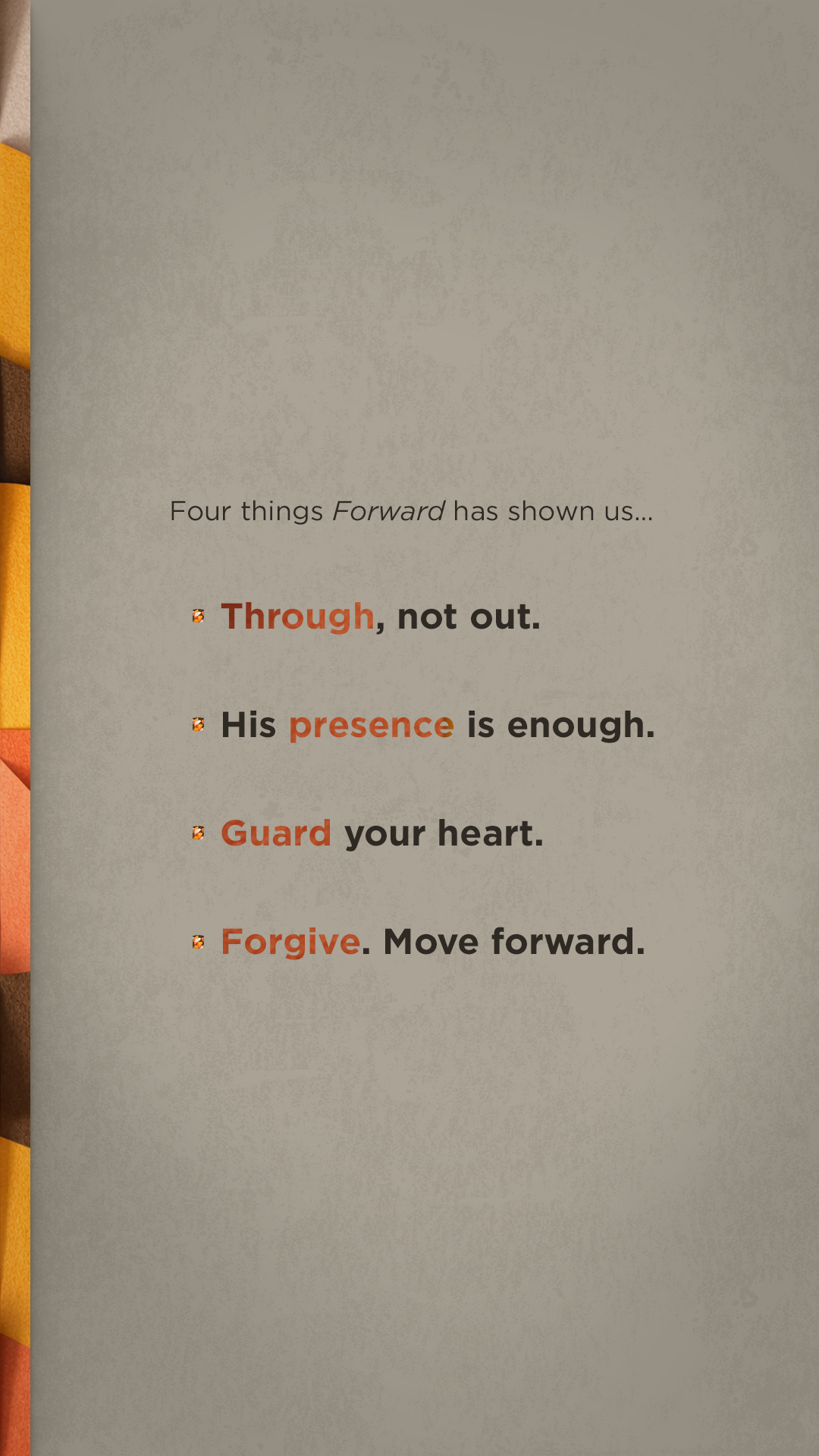
To recognize his presence in your life. We learned in the second. And the third, we learned to guard our heart from being bitter. Today, we learned to forgive and trust God with our pain.
Older, wiser preacher years ago, during an extremely difficult time in my life, said this phrase. He said, “God doesn’t waste pain. And God doesn’t waste experience.”
That statement resonated with me. Listen, you may be going through some things in your life right now. And to think about moving forward and to think, “All right, I’m gonna let God lead me through the circumstances. I’m gonna recognize his presence. And I’m gonna guard my heart from being bitter. And I’m gonna learn to forgive through all of this.”
Just know God doesn’t waste pain. Just know God doesn’t waste pain. There’s not one moment of your story. There’s not one moment of anything that God is wasting. He doesn’t waste pain. He doesn’t waste experience.
Years ago, I heard that statement. It was last week, or maybe the week before, I think it was last week, I was in Dallas, Texas at a conference with a few of our team members. While I’m there, I’m sitting there eating breakfast by myself. Just looking over, in fact, I think my daughter was with me, and I look across the hotel lobby, and I see this man that told me the statement.
His name’s Dennis. I walk over to him, and I was in gym clothes and sweaty, and I just walked right over, and I just said, like, “Hey, man, how you doing?” And he looked at me, and he’s trying to remember, and I said, and my name’s Anthony, and he’s, “Yeah.” The first thing he said, is he said, “Man, you look so much better from the last time I saw you.” Which I hear that sometimes, and I’m just like, “Man, how bad did I really look?”
I said, “You look so much better.”
And I looked at him, and I said, “God doesn’t waste pain. God doesn’t waste experience.” So later on that day, I was sitting with Corby and my daughter, and he walks by, and I grab him, and I hug him again, and I tell the entire story to my daughter and to Corby while we’re there, and we share the moment again. Here’s what I want you to catch by that story.
When he said the statement to me originally, it was so hard to take, but it was life-giving.
Saying the statement today, it’s joy.
It’s amazing.
Not because I did this thing or I trusted. Whew. Because I see the hand of God. Because he led through. Because it was him that was leading, and I chose his way. And he didn’t waste any of the pain. He didn’t waste any of the experience. He put everything together in this beautiful story that I could never write, that I could never imagine. That I could never put together by all of the things that I think would protect me, would make me stronger. All the things that you and I do that we think makes our situation better.
No, it’s him.
So if this series has hit you, hey, let him lead you through. Let him show you his hand at work in your life, and rejoice over it and go, “Everything else might be going sideways, but look at what God is doing.” Don’t choose the bitterness.
And offenses? Forgive them and forgive them and forgive them and forgive them. Because we get to see his peace in our life, and at work in incredible ways. Heavenly Father, you’re so good. God, thank you. Lord, first, thank you for bringing this series this year. Lord, it wasn’t in the plan this year, but it was in your plan. Father, thank you for how you’ve worked through each of these messages.
Father, thank you for what you’ve done in my heart and our hearts.
And Father, would you, Lord, would you have your will in your way in our lives? I pray in Jesus’ name.