Watch message
There’s Something in Me I Can’t Control

Share message
Link Copied
Key Scripture
Discussion Questions
Message Highlights
- Our problem was never that we didn’t know what to do. It’s that we can’t do it consistently, because sin isn’t only the wrong things we do. It’s a power that rules.
- Paul says sin entered the world. Not sins. Sin. A noun that results in a verb. There is sin that results in sinning, and it came in through one man, Adam.
- What Adam did to all of us, Christ undid for everyone who believes. God moves us out of Adam and places us into Christ, and gives us a right standing with him we could never earn.
Conversation Starter
- What’s something you tried to fix this summer that didn’t go the way you planned?
Core Discussion Questions
Connection Question
What stood out to you from Sunday’s message about the difference between the sins we commit and sin as something that rules us?
Context Question
Where have you run into the idea that we’re “born sinners” before, and what did you understand it to mean at the time?
Clarity Question
Anthony said we keep treating a power problem like a behavior problem. How did that change the way you think about our struggle with sin and how we often try to fix ourselves?
Application Question
He also said we don’t fight for a new identity; we fight from the identity Jesus gave us. Where have you been fighting for something God says is already true of you?
Additional Questions
- Paul wrote “I do what I hate” as a mature believer, after three missionary journeys and years of planting churches. What does it do to you to know he was still living in that tension?
- Many people say, “I’ve always been a Christian.” But the Romans passage we looked at today shows that’s not quite accurate—the truer statement is “I’ve always been a sinner.” John 3:3 and 2 Corinthians 5:17 point to a specific moment of being born again: the old self dies, and we become a new creation in Christ.
- Why do you think “I’ve always been a Christian” is such a common thing to say?
- How would you tell your own story in light of this truth?
Personal Study
Exploring the Scripture
Main Scripture: Romans 5:6–19 (CSB) Supporting Scripture: Romans 7:15–19 (CSB)
Paul wrote Romans around AD 57, near the end of his third missionary journey, from Corinth. He was preparing to carry a relief offering to Jerusalem, and after that he hoped to visit Rome on his way to Spain. He never made that trip as a free man. He arrived in Rome as a prisoner. This letter is the most systematic thing he ever wrote, and he wrote it to a church he had never visited and did not plant.
The believers in Rome were a mix of Jewish and Gentile Christians, and they were not always getting along. Much of the letter works out how both groups stand in exactly the same position before God. Chapters 1 through 4 build that case: everyone is guilty, no one is made right by keeping the law, and God credits righteousness to people who believe, the same way he did with Abraham long before the law existed.
Chapter 5 is where the letter turns. Paul has established that we’re justified by faith, and now he asks a question underneath all of it. How did we get bad enough to need it? To answer, he goes back past Abraham, past the law, all the way to the first man. Then in verses 12 through 19 he sets Adam and Christ side by side as two representatives. What each one did reaches every person connected to him. Adam’s disobedience made all sinners. Christ’s obedience makes the those who believe in Him righteous.
There’s a detail in the Greek that’s easy to miss in English. At the end of verse 12 Paul uses a verb, hēmarton, for the act of sinning. But a few words earlier, when he says sin entered the world, he uses a noun, hamartia, and once he reaches for that noun, it’s the word he keeps using through the next two chapters. Sin enters. Sin reigns. Sin fights to reign. Sin no longer has dominion. Those are things a ruler does, not things an activity does. Paul isn’t cataloging our bad behavior. He’s naming a power that took the throne, and then showing us the only one with the authority to remove it.
Questions for Study
- Read Romans 5:6–8. Paul uses three words for our condition: helpless, ungodly, sinners. What does each one add that the others don’t? Why do you think he stacks them before he gets to what Christ did?
- Read Romans 5:12 slowly. Trace what enters, what follows it, and how far it spreads. What does Paul say is the reason death reached everyone?
- Compare Genesis 3:1–7 with Romans 5:12. Adam’s act was a single decision in a garden. What does Paul say that one decision did to everyone who came after?
- In Romans 5:15–17, Paul repeats “how much more.” What is he comparing, and what is he insisting about the size of the gift?
- Read Romans 7:15–19 and notice the tense. Paul writes “I do,” not “I did.” What does it tell you about the Christian life that a mature apostle described himself this way?
- Read Romans 6:14 and Romans 8:1–2. Where does Paul say the change in our situation comes from? Who is doing the acting in those verses?
- What does Romans 5:6–8 show you about God’s character? He acted while we were still helpless, still ungodly, still sinners. What does that timing say about him?
Deeper Discussion Questions
- Many people assume sin is a list of bad behaviors, and that a better routine or more willpower would handle it. Where have you believed that, and what did it cost you?
- Romans 5:18 says justification comes “for everyone.” Some read that to mean everyone is automatically saved. Read Romans 5:17 and Romans 10:9–10. What does Paul say has to happen for someone to receive the gift?
- If Christ has already dethroned sin, why does Paul still describe a fight in Romans 7? How do you hold those two things at once without giving up on either?
- Some people use grace as permission. Paul knew that objection was coming and answered it in Romans 6:1–2. What’s his answer, and why isn’t it “try harder”?
- Plenty of people carry the sense that their family’s patterns are their destiny. What does it change to hear that you were in Adam and are now in Christ, rather than simply being your father’s son or your mother’s daughter?
- Our culture teaches that we author ourselves and that our worst moment reveals who we really are. How does Romans 5 contradict both of those?
- Be honest about the gap between what you believe about grace and how you actually respond when you fail. Do you run from God or to him? What does your reflex tell you about what you actually believe?
Living It Out
- Name what’s underneath. Identify one thing you keep trying to manage on your own. Write down not just what you did, but what you wanted when you did it. Bring that second part to God this week.
- Tell one person. Sin holds ground in secret and loses ground when it’s spoken out loud. Choose one mature believer and tell them the thing you’ve been handling alone. Ask them to check in with you in two weeks.
- Pick one specific act of obedience. Not a resolution. One concrete thing: block the access, make the call, confess the secret, end the conversation, reconcile the relationship, open the Bible before you open the feed. Choose the one you already know and do it before Sunday.
- Answer the accusation. When something tells you “this is just who you are,” say back what’s true: that was who I was in Adam, and I belong to Christ now. Notice how often you have to say it this week.
Prayer Focus
Start with reflecting on Romans 5:8. God moved toward us while we were still helpless. Thank Him for that before you ask him for anything. Then bring him the one struggle you've been wrestling with. Don't ask for the willpower to manage it. Ask God to do in you what you've already proven you can't do in yourself. Pray for someone in your group who is still fighting for something God says is already true of them. Ask that this week they'd believe it. Close with, "God, you dethroned sin when no one else, including myself could. Help me to live like it's true."
Transcript
Hey, we’re starting a brand new series called “Freedom.”
Did you ever feel like a prisoner? Oh, I don’t mean a prisoner if you got locked up for doing something that you shouldn’t have done. Then you definitely felt like a prisoner, because you were. I mean, did you ever feel like a prisoner because of your own problems? I mean, the situations, the circumstances, the things that you’ve done to yourself for the scenario that you created yourself, for yourself, and you felt like you were in prison. And here’s the thing, it’s impossible. It’s impossible to feel freedom. It’s impossible to solve a problem when you don’t know what the problem really is.
And we’ve all tried this. I mean, we’ve all tried to solve a problem that we’ve created for ourselves when we really don’t know what the problem is, or for that matter, even how to solve it. Hey, and it’s even worse when the problem that you’re dealing with is you. It’s even worse for me when the problem that I’m dealing with is me. I mean, there have been multiple times where I realized that I created circumstances for myself, and I had to go like, it’s me. I’m the problem, it’s me. See, there was an age gap generation there that kind of missed that, okay?
And many of us, we’ve been trying to solve a problem for ourselves for a long time, and we’re no closer than when we started. And sometimes the reason is because you can’t solve a problem that you can’t diagnose. We’ve got lots of theories, and we try all kinds of things, but we still can’t quite put our finger on what’s wrong with us.
But we see the symptoms. Sometimes it’s a lost job. Sometimes it’s a relationship or a marriage that just crumbles and falls apart. Sometimes it’s money, and when you have the money problems, you’re like, I see the symptom of the problem, but I don’t know what the problem actually is. It might be your sleep, your self-esteem, your reputation, all the while not knowing what the problem actually is, and you end up chasing a fix for a problem that you never actually identified.
See, knowing what the problem is isn’t the same as having a solution for the problem, because if you’re solving the wrong problem, even if you have the right solution, it still doesn’t work. It doesn’t fix you, and it doesn’t fix me.
So in this series, I wanna show some explanation to what our problem actually is. What’s wrong with you? What’s wrong with me based on what the apostle Paul taught in the New Testament? The apostle Paul under the inspiration of the Holy Spirit penned down these words for us to tell us something about us that if I’m honest with you and you’re honest with me, we really don’t wanna know about each other. I don’t wanna know the full truth about me.
Throughout this series, we’re gonna be studying through the book of Romans primarily today in chapter number five. To kinda help you understand where we’re going with the message with this series, I wanna kinda jump ahead. We’re gonna be in chapter five, chapter six, most of this series, but I kinda wanna jump ahead and talk with you two chapters later about what the apostle Paul says about himself, how he describes himself and how he’s the problem. It won’t be on the screen, but I’m gonna read it to you.
Romans chapter number seven says, “I don’t really understand myself, for what I wanna do is right, but I don’t do it. Instead, I do what I hate. But if I know what I’m doing is wrong, this shows that I agree with the law.” He’s saying, “If I know what I’m doing is wrong, I realize that it’s wrong, that it’s against God.” But he says in the next verse, “And I know that nothing good lives in me that is in my sinful nature.” What I want to do, what is right, but I can’t. He says, “I wanna do what’s right, but I can’t.” Then he says this, “I wanna do what is good, but I don’t. I don’t want to do what is wrong, but I do it anyway.”
They sure feel like that. Like you leave church on Sunday and you’re like, “This week is gonna be different. I’m gonna be spiritual. I’m gonna be on fire for God. I’m gonna read my Bible every single day this week. I’m gonna do everything right.”
And then you pull out of the driveway, you hit the first roundabout, and the car in front of you treats the roundabout like a stop sign. And you wanna like hit your horn, right? You wanna do all the things, but you know you followed that car from its bumper right out of this parking lot, right to the roundabout. And you’re resisting the urge. And you grab the bottom of the steering wheel, and you’re holding it really tight, and you’re like, “Would you just drive your car?” See, how do you know that? I read it in a book one time.
But I want you to catch what the Apostle Paul said here. He said something. He said, “Hey, I do. The things that I do, they’re not the things I wanna do. Hey, the things that I do, they’re not the things I should do. I’m doing something that I know is wrong that I don’t want to do.”
And I want you to catch this, the Apostle Paul, after he’d been saved, after he had seen the post resurrected Jesus. Everything that God did in his life, using him to pen Scripture, he said, “I do.” Present tense. Not past tense. Paul isn’t looking back on who he used to be before Christ. This is the Apostle Paul writing as a mature believer, still living in the tension of, “I am doing this, but I want to do this, and I’m struggling.”
Hey, that’s true for him. It’s true for us, which means the goal isn’t today that the feeling of that tension, the problem, “I do this, but I want to do this.” The goal today isn’t that that feeling, that tension goes away, the goal. The goal is gonna be figuring out who actually has the final say over you, over me, even when the feeling of that tension is still there.
You might say, “Well, you know, this would all just be fixed if somebody just did what they were supposed to do.” Yeah, you’re right. I mean, can you imagine how great church would be? We’d come in, we’d lean into worship like we did today, we’d sing about the Savior, about Jesus, we’d lift his name on high. I could get up here on the platform and just go, “Listen, whatever you’re doing, stop it. See you next week.” I mean, that would be great.
See, but the problem is, way deeper than all of that. The problem has never been that we don’t know what to do. Come on, we all know what to do. The problem is that we can’t do it consistently. And the Apostle Paul shows us why and what actually changes the problem doesn’t change the tension, but it changes the outcome.
The book of Romans is written to Christians in Rome, mostly Gentiles, some Jewish. Paul says here, what he says here matters as much for us today as it did for those original readers. Romans chapter number five, verse number six, in the beginning part says this, “For while we were still helpless,” he’s pointing ahead to something he’s gonna unpack later, this sense of helplessness. I’m gonna tell you what allows us to struggle more than we should is sometimes we think we’re stronger than we are when we are helpless. He says, “For while we were still helpless, at the right time, Christ died for the ungodly.”
Hey, in order to understand the problem, understand what the solution is, you have to acknowledge the reality. We have to acknowledge the reality of us. You, me, you say, well, what’s our reality? I know I sin and I know I do wrong. No, our reality is far worse than that. It says it right here in the verse ungodly. Hey, we’re ungodly.
Look at what he says next. “But God proves his own love for us in that while we were still sinners, Christ died for us.” And when Christ died, he died for your past sins, your present sins, your future sins. And maybe you’re still stuck on that word ungodly. Maybe we know we’re not perfect, but ungodly. No, no, we’re ungodly.
See, Paul told us we’re reconciled, we’re justified, we’re at peace with God, and now he answers the question underneath all of that. How did we get bad enough that we needed reconciled to God in the first place? And he tells us. And he tells us why we’re ungodly and why our condition is far worse than we actually think it is. He goes all the way back to the first man.
Look at verse number 12. “Therefore, just as sin entered the world through one man, and death through sin, in this way death spread to all people because all sinned.” Paul says sin entered. He doesn’t say sins. He says sin. Something came in and death came with it.
I say this a lot, but I wanna say it again. Sins are not something that stack up. They’re not actions that you do, though they are things that you do and actions that stack up. Sin is the sin nature that dwells inside of you that does all of those things. We’re really good at looking at the tangible action of sin, the things that we do, the things that we say, the places that we go that we shouldn’t go. But Paul is describing something far greater. It’s the nature that’s inside of us.
There’s a distinction here that’s easy to miss in English, and I’m gonna do my best to explain it to you. When Paul says all sinned at the end of the verse, he uses a verb pointing to the act itself. But then he says sin entered the world a few words earlier in a noun. And once Paul reaches for that noun, it’s the word that he keeps using throughout the rest of the chapter. He says it, sin enters, sin reigns. In chapter number six, he says sin fights to reign. It’s still in chapter number six, sin no longer has dominion over you. The sin is not just the activity that we do, it’s the thing inside us that rules us.
So how did we get that? The Bible says it’s through one man. And Paul will name him in a few minutes, in the few verses as we get there, but it’s Adam, Adam sinned. And when Adam sinned, sin took the throne. And this matters for the weeks ahead because Paul’s describing sin as an activity, and it’s a thing that produces an activity, a noun that results in a verb. There’s sin that results in sinning.
And come on, we’ve seen this. Like we’ve watched sin kill and destroy relationships. Some of you have seen sin kill and destroy your finances. You’ve seen it kill and destroy your home. Maybe you’ve got a great marriage, but you’ve got an awful relationship with your kids. You say, well, what sin could cause an awful relationship with my kids? Pride. Hey, pride’s always the problem. You come down to the root of sin itself, go down to any sin you want to, and you’re gonna find pride in every sin. And it might be a career, it might be a different relationship, it might be some other thing, but you’ve seen sin kill and destroy time and time again.
And the Bible says this in verse number 12, “In this way, death spread to all people because all sinned.” Which means your problem isn’t your sinning. Your problem is that you were born a sinner. My problem is I was born a sinner.
And this might contradict your understanding of your own theology, because I hear people say this all the time, well, I’ve always been a Christian because I’ve grown up in church. No, you haven’t. Well, I’ve always been a Christian because my grandfather was a preacher. No, you’re not.
So how can you say that so bluntly and so plainly? Because you are never the solution to your own sin. Jesus is the only solution to sin. I don’t care how long you’ve been in church, I don’t care how many people you’re related to in church, I don’t care how much money you give, I don’t care what you do, how you serve, how faithful you are. Sin, sin is what separates us from God. And the sin has to be forgiven to have restoration with God.
Listen to me, that’s why the job, the marriage, the sleep that you’ve lost trying to fix some problem, that’s why it’s never gonna work. It’s why you’re gonna keep on trying to grab the symptoms of problems rather than actually solve it.
And the reason is because we keep treating a power problem like a behavior problem. When it comes to addressing the sin in our life, we address a power problem like a behavior problem. Well, if I can just change this one habit, if I can just change this one thing, then everything in my life will kind of fall back into place. There is a power in here that we keep trying to create, we keep trying to fix like a behavior out here. And let me say it like this, we can’t outperform something that’s already sitting on the throne of our lives.
See, this sounds really serious. Yeah, it is, let me explain to you like this. Nobody ever had to teach you how to sin. It comes naturally. It comes naturally because both of us, all of us were born into sin in Adam, his one trespass infected the whole race. And eventually every person reaches the same conclusion, there’s something in me I can’t control.
Look at chapter five, verse number 15. But the gift, that’s such a beautiful word, but the gift is not like the trespass. For if by one man’s trespass, the many died, and I’m gonna kind of pause here for a second, because he hasn’t used this word gift up to this point. But in a minute, he’s gonna define it as the right standing with God and the trespass, was Adam’s one act in the garden that condemned everyone, but the gift you receive when you believe is nothing like the trespass.
I wanna explain this, the many that died, that’s all of us in sin, in Adam, all born into sin, spiritually dead, separated from God, because of the one trespass of Adam’s sin. Look at the rest of the verse. How much more have the grace of God and the gift which comes through the grace of the one man Jesus Christ overflowed to the many? Hey, just as we’re born, all born into Adam, when you become a Christian, you’re taken out of Adam and placed in Christ. And the contrast between these two states, powerful, it’s so practical, it’s so real, I don’t want you to miss it.
You might say, so why does it feel like there’s a power in me that overrides my will? I mean, I know I’m gonna regret it. I’m gonna know, I wish I wouldn’t have done it. I’m gonna wish that I could take it away and undo it in some way. But it feels like there’s no way out. And Paul says that we’re enslaved to sin being born in sin.
Listen to me, this is not a generational curse. You were born in sin. Don’t take a passage of scripture out of context and go, well, because my father and his father before him did something, that’s why I do it. No, the reason that you do it is that you were born in sin. By your nature, you are a sinner and the solution isn’t breaking some generational curse. No, the solution is Jesus Christ and being placed in him by faith for the forgiveness of your sin.
Listen to me, sometimes we try and get so clever with things that we try and find in the Bible that nobody else has ever seen, that we start undoing the most practical theology that we could ever understand. We were born in Adam and we put our faith and trust in Jesus, we’re placed in Christ. And being placed in Christ is more powerful than the curse.
Look at verse number 16. And the gift is not like the one man’s sin because from one sin came the judgment resulting in condemnation. But from many trespasses came the gift resulting in justification. And this is an incredible thing God has done in Christ. It can’t even be compared to the result of sin. They’re so far apart from each other.
And here’s what it means. Because we were born in Adam, we’re born condemned. But when you place your faith and trust in Jesus Christ, you’re taken out of Adam and placed into Christ and you’re given a gift of having a right standing with God. That’s called justification.
And in addition to justification, the implications of moving from Adam into Christ, it’s not just about what happens when you die. See, we think of being taken out of Adam and placed in Christ and we’re like, yeah, and that means I’m gonna go to heaven when I die. Yes, you’re right. But there’s so much more than just going to heaven when you die, it’s about how you live here on this earth.
Hey, because you’ve been saved, because you’ve been redeemed, you don’t live in this power. You live in this freedom. But so many of us, we have the promise of the freedom of Jesus Christ, but we still allow ourselves to live subject to this power that shouldn’t have any rule over us.
And I know what you’re thinking. You’re probably thinking like, yeah, you know what? We’re taken out of Adam, we’re placed in Christ. And so what you’re gonna tell me is, I just have to try harder. I have to pray harder, I have to do better works, I have to commit myself even more. No, no, no.
I’m gonna tell you what it is. It’s not about trying harder. It’s about what’s true of you now. You’re no longer in Adam and you’re in Christ. And I’m gonna unpack this a lot more next week and the week after.
But look at verse number 17. If by one man’s trespass, death reigned through that one man, how much more will those who receive the overflow of grace and the gift of righteousness reign in life through the one man, Jesus Christ?
Here’s what he’s saying. You can reign over the very power that used to have power over you. You don’t have to let this control you. The Bible’s saying you can reign over this power but not in your own strength. It’s because Christ is in you. It’s because you’re in Christ.
And that doesn’t mean that the Romans seven feeling vanishes overnight. No, you’re still gonna have that pulling back and forth and that tension because there’s still that old nature that’s still inside of you, but also the old nature and you are in Christ and you are not subject. You are not under the control of who you were in Adam and throughout this whole series, we’re gonna talk about how that practically is lived out in our lives.
But for today, here’s what’s true. We already know that the life in Adam looks like sin has the control. So the question is whether life in Christ can actually produce and overpower what happened to us in Adam and Paul says, yes, it can.
Look at verse number 18. “So then as through one trespass, there is condemnation for everyone. So also through one righteous act, there is justification leading to life for everyone.”
And here’s what it means. A in Adam, sin entered and touched everyone. And Jesus paid the penalty for that sin and undid what Adam did and we can be in Christ, free from sin in Adam if we put our faith and our trust in him.
Look at verse number 19. “For just as the one man’s disobedience, the many were made sinners. So also through one man’s obedience, the many will be made righteous.”
And here’s what Paul is saying. Hey, if your approach to the Christian life is, hey God, thanks for forgiving me. Hey, thanks for forgiving me. And I know you took me out of Adam and you placed me in Christ. So now I’m just gonna do my very best for you. Can I tell you something? You’re gonna fail.
Yes, you were placed, you were in Adam, you were pulled from Adam, you were placed in Christ because you put your faith and your trust in him. And if you try and go do your very best for Jesus on your own, in your strength, you’re gonna fail.
And this is the very thing that the apostle Paul was talking about in Romans chapter seven. He says, listen, I agree with the law. I agree with the law, but I can’t seem to do what I know to be good. And there is massive implications being taken out of Adam and placed into Christ by faith.
But we don’t get this because our instinct is always, hey God, thank you for what you did. Now I’m gonna try and do my best for you.
And we try and muscle through in our strength to do our best for God. Now hear me, when we try and muscle in our strength to do our best for God, we’re not doing it out of this place of in Christ where there’s freedom. We’re over here living what we’ve been freed from, trying to somehow do good. And we can know right and wrong and we can know what’s wrong, but here’s the thing. We keep doing wrong because we keep acting like we’re in Adam.
And here’s the point, if you’ve put your faith and your trust in Jesus Christ for the forgiveness of your sin, something changed at the core of who you are. And everything that follows in Romans teaches us how to live by what is true of you being in Christ, not who you were, but who you are now.
Hey church family, that’s how we ought to live. Not who we were, not what we were saved from. But by the power of our savior who dwells inside of us.
I’m gonna give you a couple things and a couple of ways to practically live out the message today. The first one’s this, stop treating a throne problem like a habit problem.
And you’re not merely someone who occasionally does sinful things. Hey, apart from Christ in Adam, sin has the power that rules over us and Paul says it reigns. So quit settling for surface level fixes.
People say this all the time, well, I just need to be more disciplined, no, you need to walk in Christ. Well, I just need a better routine. And if I have a really good routine, then I won’t keep on messing up the way I’ve been messing up. No, you need to recognize who you are in Christ.
People keep saying, well, I just need different relationships around me and that somehow I have different relationships around me, I will just probably be better off on the inside. Maybe I just need less stress. No, you’ve got to realize who you are in Christ.
Bring the problem all the way into the light. Don’t only confess what you did, confess the self rule beneath it, the desire to be your own God, to define your own good, to sit on the throne of your own life. Hey, somewhere along the way, we’ve got to get honest with God about our sin. And when we do that, that’s mature Christianity. See, sin grows in secrecy and it loses ground when we name it and we bring it into the light before our savior.
And here’s the crazy thing, he already knows about it. He already knows about it. Why don’t we just own it?
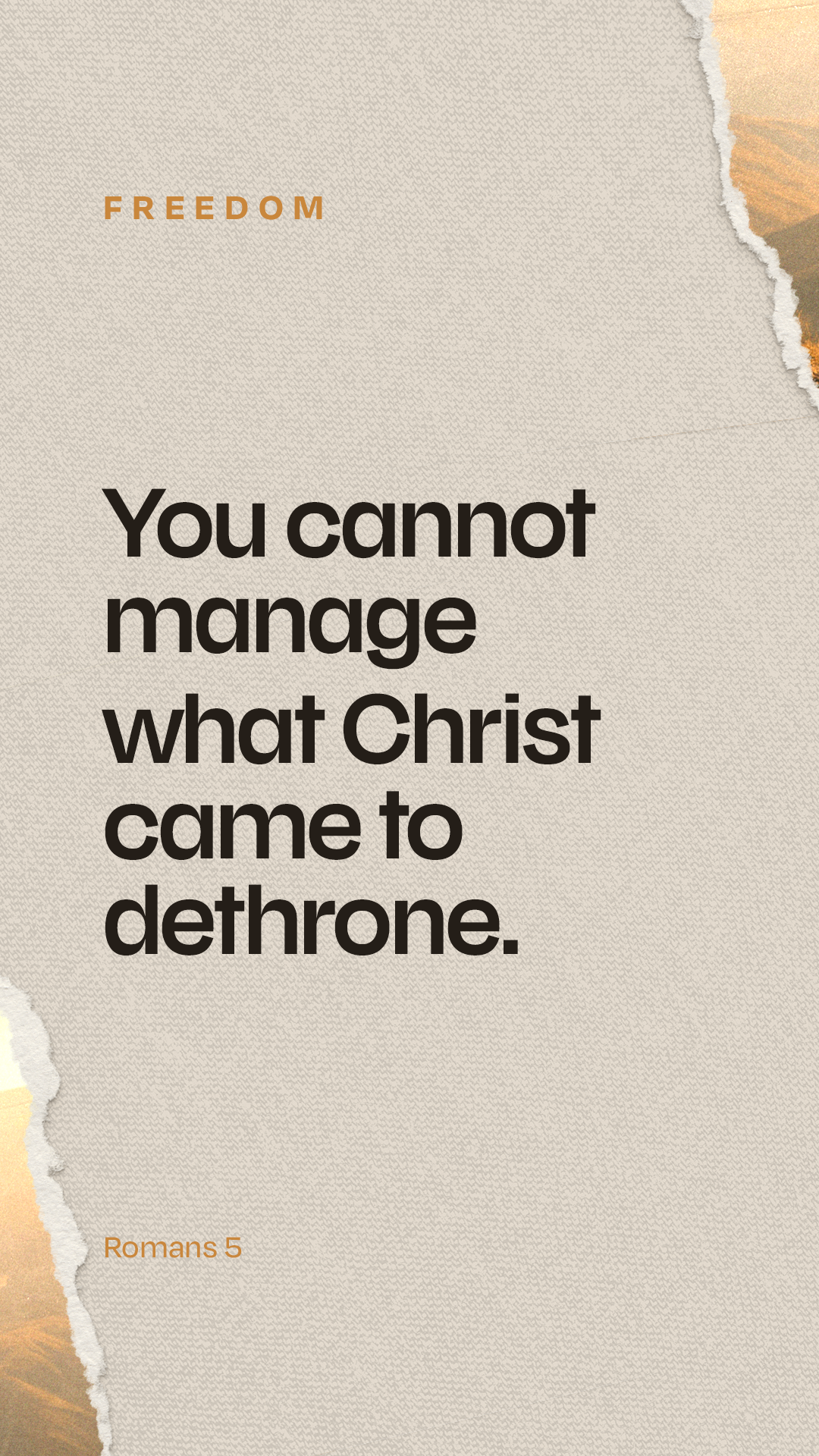
Let me say this, hey, you can’t manage what Christ came to dethrone. There’s us in Adam, it’s us in Christ. And God sent his son in his love and in his mercy and in his grace to create a solution to take us out of Adam that we would be in Christ. And here’s the problem, we keep trying to manage this old life in Adam. Rather than dethrone this and live in the power of Jesus Christ.
Listen to me, you can’t manage your life, you can’t manage your worst acts, you can’t manage your bad habits, you can’t manage the things that you’re tempted with, you cannot manage yourself, you’ve got to live in the power of being in Christ, not in Adam.
Let me give you this next thing, how to live out the message. Receive your new identity before you attempt your new behavior. Hey, the gospel is not God, you forgave me. Now I’m gonna prove how serious I am. No, the gospel it was or is, in Adam you were condemned. In Christ you’ve received righteousness and a new standing before God.
When you fail, don’t run from God like a condemned person. Run to him as a child who has been justified by Jesus Christ. Listen to me, receive your new identity, understand who you are before you try and muscle your way into different behavior.
See, but I just, I know it, I’m gonna try this and I’m gonna fail, yeah, and when you fail, run to Jesus. And when you fail tomorrow, run to Jesus. And when you fail again, run to Jesus.
Listen, stop letting your worst moment name you. Stop letting your temptation name you, even though I know your temptation for you is very real. Stop letting your struggle that is real name you. None of these things have the authority to tell you who you are. Only Christ has the authority to tell you who you are. And he came and he died for that sin so that you could experience freedom.
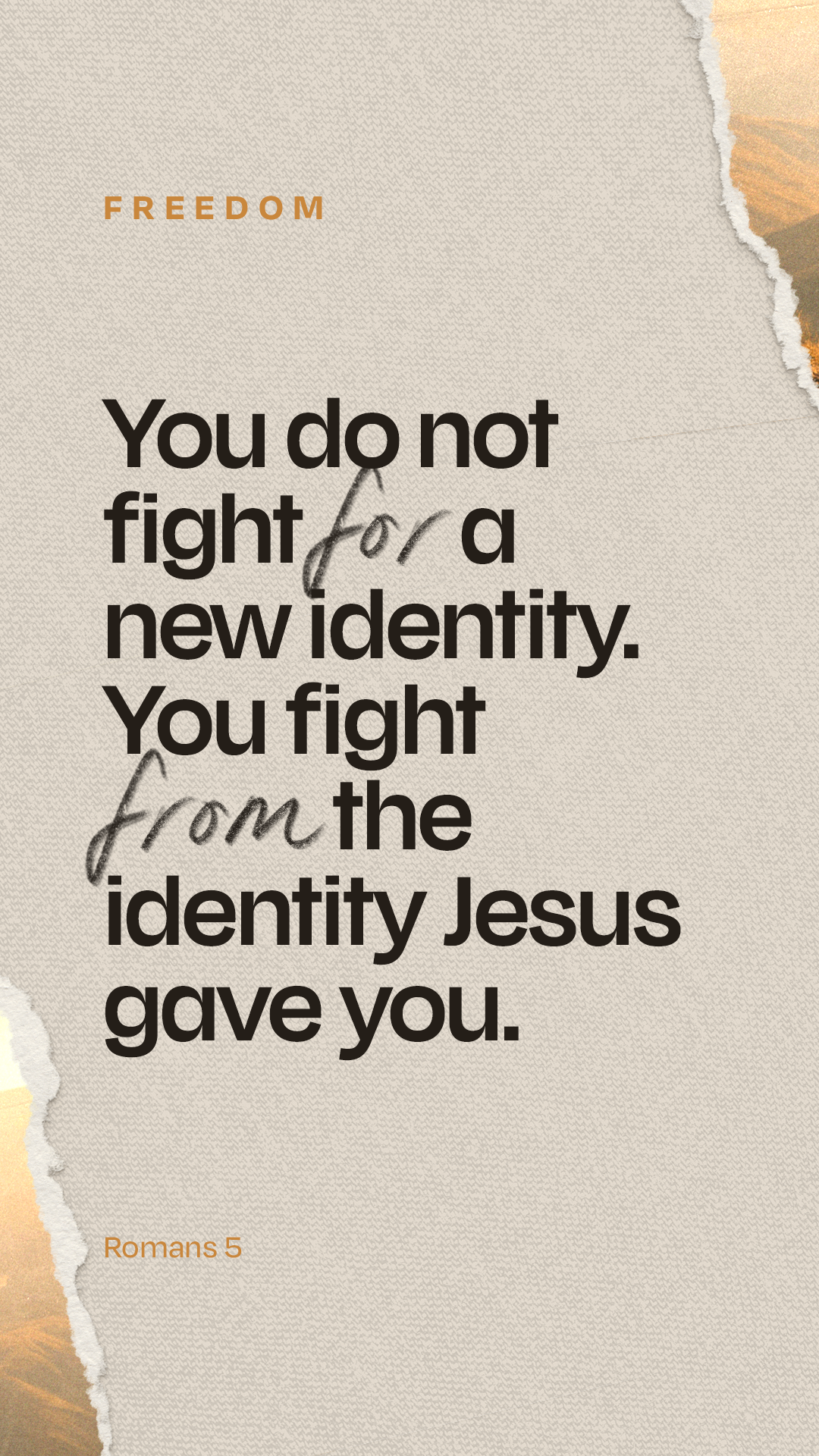
Listen to me, be obedient. Bring your obedience with what is already true of you. I am in Christ, I’m not earning acceptance, I’m not living for acceptance, I’m living from acceptance. Let me say this to you, you do not fight for a new identity. You fight from the identity that Jesus Christ gave you.
Too many of us are trying to fight our way out of being in Adam when we’ve already been pulled from Adam and placed in Jesus Christ, and we try and fight our sin nature all on our own. And Jesus is telling you and he’s telling me, and we read it in the book of Romans. Listen, you don’t fight for your new identity. You fight from who you are in Christ, and that is what gives you the victory.
You don’t fight by trying harder, by being better. And apart from Christ, none of us can do it. You fight from your identity and who you are in Jesus Christ. We have no power to fight for. The power that we have to fight comes from our identity in Christ.
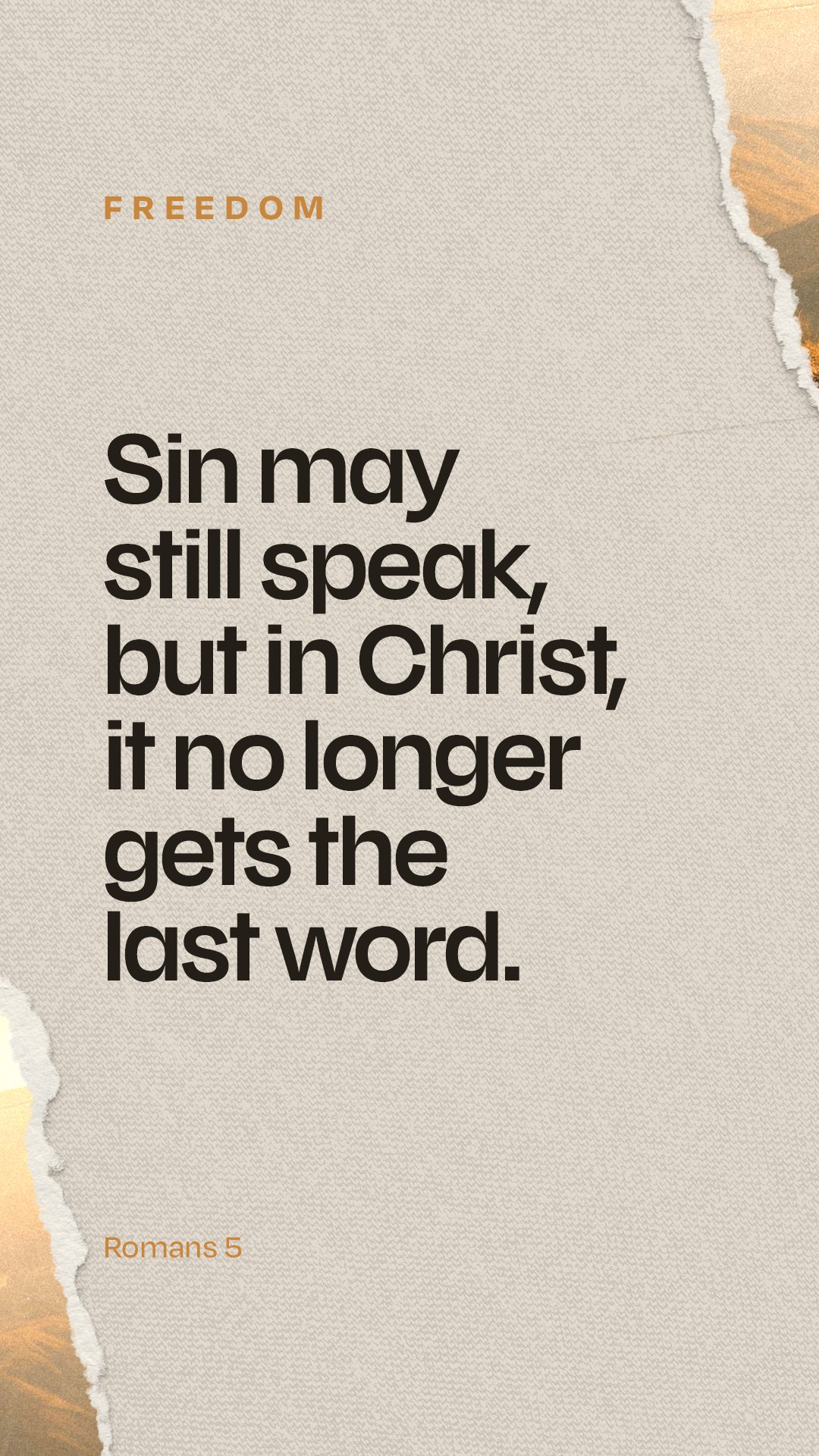
Last one I want you to see, refuse to give sin the final word. Romans seven may describe the tension that you feel, but Romans five describes the authority that you have. Listen to me, grace reigns through Jesus Christ. Hey, the battle may still be allowed. It may still be difficult, but sin is no longer lord over you because Christ came to save you.
And if you’ve put your faith and your trust in him, you are, you’re in Christ. Listen to me, when temptation says, this is who you are, so you might as well give into the sin anyway. That’s your old life talking. Hey, that’s who you were in Adam.
Listen to me, some of you are struggling right now. That’s who you were in Adam. That is not who you are in Christ. So refuse to give sin the final word. Your savior has authority over everything.
Listen to me, replace vague solutions with specific obedience. Stop saying, I just got to do better.
No, say from my new identity, I’m gonna block the access. From my new identity, I’m gonna make the call. I’m gonna confess the secret. From my new identity, I’m gonna end this conversation. I’m gonna be done with all of it. From my new identity, I’m gonna reconcile that relationship, not in my own strength and not in my own power. And from my new identity, I’m gonna open up the Bible. I wanna hear from God in a different way.
Maybe you’re sitting in the room right now. You’re going, Anthony, this is my first time here and I feel that struggle. I feel that fight back and forth and I just feel like, I feel like Anthony, I only feel half the struggle. I feel like I feel the part that just sin has control over me, but I don’t feel that other side.
Hey, if that’s you, I’d love to talk with you. I would love to open the Bible and show you more than I’ve showed you today, to show you how God and his love and his mercy sent his son for you so that your sin could be forgiven. Your past sin, your present sin, your future sin.
So how can God forgive my future sin because it’s dealing with a nature and not a bunch of actions that stack up. The actions come from the nature and I’d love to show you how putting your faith and your trust in Jesus takes you out of Adam and places you in Christ. For you to see that in the word of God.
And I’ve seen this countless times with people in that moment, they understand the gospel and they bow their head and they put their faith and their trust in Jesus and it radically changes them. You say a prayer, no, not a prayer. You say, well, a moment with the pastor. No, not a moment with the pastor. A moment when somebody realizes they were born in Adam and the solution to everything is being placed in Christ.
And if you’re a believer in the room, you’ve lived this. Come on, this is why we sing about Jesus. This is why we get excited about what we hear in church. It’s not just a rally around some things. Celebrating who we used to be but now really celebrating who we are that we were freed from this to be alive in Christ.
Maybe you’re here and again, maybe it’s your first time and you’re like, I want that. Hey, I want you to find me in the lobby after service today. I want you to find me in the lobby because I wanna talk with you. I wanna share the gospel with you. If I can’t sit down with you, I want someone else to sit down and open a Bible so that you can see it in the word of God.
The church, what if we stopped living trying to manage a behavior problem when really it’s a throne problem? Hey, what if we left here today living in the power of Christ rather than struggling in our own power?
What if we lived here today saying, I’m gonna live in victory, not because of my decisions and not because of my strength and not because of my ability, but because of who Christ is and what he’s done and how he’s changed me and how he saved me and I’m gonna live in that freedom. Not because I broke free on my own way or broke free from myself because God who was rich in mercy sent his son and he saved me and he redeemed me and took me out of Adam and placed me in Christ.
Listen to me in a moment, that’s what we’re gonna sing about. And when we sing it, maybe that you just need to stay seated for a moment, you need to talk to the Lord. Hey, do that. And it may be that you sing out and you worship and you celebrate what Christ has done. Hey, do that. If God’s speaking to you, lean into what he’s saying. Listen to him and respond.