Watch message
Purity Isn’t the Goal

Share message
Link Copied
Key Scripture
Transcript
If you’re new here to Northwest, we are in Psalm chapter number 101 today and we’ve been in a series throughout Psalms and it’s been incredible to see what God has been doing. Let me ask you a question. What do you think of when you think of the word purity? And when you see a pastor like me standing on a platform like this and they say the word purity, what comes to your mind? Maybe right away it’s staying away from sin and you think you know I’ve just got to stay away from sin or maybe it’s a long list of rules that you’ve got to follow so that you don’t cross the line. You say what’s the line? That’s been the question I’ve been asking my whole life. But I can’t cross that line. Or maybe you think of keeping yourself separated from the world and if you can keep yourself separated from the world that must mean that I’m pure. But for a lot of people what it is when they hear that word purity, when they hear a sermon on the title of purity, they start thinking of a list of rules of a bunch of restrictions. Things that they can’t do, things that they should do, what they shouldn’t watch, what they shouldn’t say, where they shouldn’t go, a line that they shouldn’t cross.
And here’s the thing I want you to catch from the very beginning. If we’re not careful we begin to think purity is simply the absence of bad behavior. Let me say that again. It’s so important for where I’m headed today. If we’re not careful we begin to think that purity is simply the absence of bad behavior. See purity isn’t the absence of bad behavior because I have a sin nature and you have a sin nature. You have a part of you that desires to sin and desires to do wickedness. And if you’re a believer in Jesus Christ, if you’ve accepted Him as your Savior, He’s made you a new creature and He’s come inside to dwell within you and those two natures the Bible says war against each other.
You might say well then if it’s not a list of rules, it’s not some things that I do, then how, how do I remain pure? Psalm chapter number 101 gives us a very different picture. David doesn’t begin with a list of rules. In fact he begins with worship. He doesn’t begin with what he’s avoiding. He doesn’t talk about all of the things that he’s not going to do. First he starts with who he’s pursuing.
This psalm was likely written near the beginning of David’s reign. Then as he takes the throne, David makes a series of commitments. You’ll see them as we’re reading. He says over and over again, I will, I will, I will. But these aren’t mere resolutions. They’re commitments of a man who wants his life, who wants his home, who wants his kingdom to reflect the character of God that he loves. I want you to catch this. This is so important. Biblical purity isn’t merely avoiding sin. It’s living with an undivided heart before God.
So Psalm chapter number 101 verse number one says this, “I will sing of loving kindness and justice to you, O Lord. I will sing praises.” David starts where every pursuit of holiness ought to start. It starts with worship. So before he talks about behavior, he talks about God. Before he talks about purity, he talks about praising God. And he sings of God’s loving kindnesses, his faithfulness, his steadfast love. And then get this, his justice, his righteous, his righteousness, his holiness. And notice that David worships all of God, not just the parts that he enjoys. He’s not in it for simply the blessings or the mercy. He delights in the whole character of God.
And this is so important because purity can’t survive on rules alone. I was taught growing up that if you had the right rules, if you had the right way to live, then you would be pure. Pure in your heart, pure in your mind, pure in your life. See, rules may restrain behavior for a season. And fear may alter behavior temporarily, but only delighting in the Lord changes the desire that’s in our hearts. The heart always follows its greatest treasure. Let me say it like this, whatever your heart is set on, that’s what it will follow. And if Jesus is beautiful to us, if he is everything to us, then obedience becomes the joyful response in worship.
See, the battle for purity is not ultimately a battle for some of the right rules. No, the battle for purity is a battle for affection. Look at verse number two. “I will give heed to the blameless way. When will you come to me? I will walk within my house in the integrity of my heart.” There’s so much packed in that one verse right there. The word “blameless” doesn’t mean sinless perfection. It means integrity, wholeness, a life that’s consistent, that’s not divided. David says, “Hey, the man that I am in public, I want that to be the same man that I am when I’m in my private place.” Hey, when I’m in my private place and no one can see me, I want to be the same person. And you know what happens to us as we hear that, we go, “Well, you know, if I want to be consistent, then if I’m gonna be a bad guy in public, I also ought to be a bad guy in private.” Hey, if that’s your thought process, you’re missing the whole point. That’s not purity, that’s pride.
Right in the middle of this verse is a statement that often gets overlooked. David says, “When will you come to me?” David is longing for the presence of God. This isn’t merely a king making some promises. No, this is a worshipper of God longing for a relationship, longing for communion with God. David understands something that so many believers miss, that purity isn’t ultimately about God leaving. Purity is about enjoying the presence of God. I heard this preached so many times, I heard it growing up. Hey, if you sin, you’ll miss out on the presence of God and you won’t walk with God. Now hear me, that’s true. Listen, when we’re in sin and we’re away from God, it’s sin that separates us from God, even if you’re a believer, our relationship with God gets hindered when we’re walking in sin. And so the statement is, if you sin, you’ll miss the presence of God and you’ll miss a relationship with God. Hear me, that is true. Our sin affects our relationship with God, but purity is far more about enjoying the presence of God than being afraid to lose the presence of God. The goal isn’t simply avoiding sin, the goal is fellowship with God. The point is, is that I enjoy my relationship so much with God that when I see sin, I don’t want it.
We spend so much time as believers seeing sin and saying, “No, I have to avert my eyes. No, I have to look away.” Those are all good things, but those things don’t change the heart. It’s just the outside. And David is saying, “I want my heart to be so attached to my Lord that what I see in this world doesn’t have the effect on me that it desires.”
David is saying, “I’m gonna walk within my house with the integrity of my heart.” And I want you to think about that. We read that, we just kind of run past it. David is a king in a palace. He can do whatever he wants in the palace. Anything that he wanted would be brought to him, whether it was right or wrong, it would be brought to him. And David is saying, “In the place where I can have anything I want, I still want my heart to be right.” Hey, what if we live that? I’m not talking about our reputation. I’m not talking about what people think about us. I’m not talking about what people say. I’m saying in the place where nobody sees you, the place where no one knows you, you’re still saying in your heart, “God, I want you to be pleased.”
David says in Psalm 101 verse number three, he says, “I will set no worthless thing before my eyes. I hate the work of those who fall away. It shall not fasten its grip on me. A perverse heart shall depart from me. I will know no evil.” And David gets really practical here. And he moves from the heart to the eyes. There’s a reason that he does that. David moves from the heart to the things that shape the heart. He says, “Well, what shapes the heart? Your eyes. What you see affects your heart. Your mind, what we think affects our heart. Our affections, what we desire affects our heart.” And David is saying, “The things that shape my heart, I’m gonna put some boundaries on those because I want my heart to be right with God.”
He says, “I’m gonna set no wicked thing before my eyes.” The word worthless, the word wicked, doesn’t just mean immoral. It means empty, futile, spiritually destructive, anything that pulls the heart away from God. And the principle is this, you might want to write this down. It’s not on your notes. It won’t be on the screen. What captures your attention eventually shapes your desire. Hey, what captures your attention eventually shapes your desire. I’m gonna give you another one. What continually enters your mind eventually influences your heart. What continually enters your mind eventually influences your heart.
So let me ask you, what captures your attention? Let me ask it like this. What do you allow to capture your attention? What do you allow to influence your mind? See, David understands that purity isn’t merely resisting temptation after it arrives. There’s so many people, their definition, their idea of resisting temptation is once temptation comes, then I have to fight to resist it. And David is saying, “I want to fight this fight far away from my heart.”
David says this, he says, “A perverse heart shall depart from me.” He’s rejecting a crooked way of thinking, a twisted view of life, a heart that has become bent away from God’s truth. Then finally in the verse he says this, “I will know no evil.” The word “know” here is original word is yada, generally indicates the knowledge gained through direct experience, relationship, or intimate involvement. And David is saying, “Hey, when there’s evil, I don’t want to be involved in it. I will know no evil.” The statement isn’t ignorance. It’s not isolation. He’s not pretending that evil doesn’t exist. Instead, David is refusing intimacy with evil.
He says, “I’m not going to cultivate a close relationship with sin. I’m not going to make peace with what dishonors God, because eventually what you and I tolerate becomes what we embrace.” We’ve seen that in our society. What we tolerate eventually becomes what we embrace. And there’s so many of us in this room. We tolerate so many things that are far, far, far from God.
Look at verse number five. “Whoever secretly slanders his neighbor, him will I destroy. No one who has a haughty look and an arrogant heart will I endure.” Verse number six, “My eyes shall be upon the faithful of the land, that they may dwell with me. He who walks in a blameless way is the one who will minister to me.” Hey, the one who’s doing right, here’s what he’s saying. That’s the person I want speaking into my life. Verse number seven, “He who practices deceit shall not dwell within my house. He who speaks falsehood shall not maintain his position before me. Every morning I will destroy all the wicked of the land, so as to cut off from the city of the Lord all those who do iniquity.” This is just like we spoke about a couple of weeks ago. David is saying, “Lord, when it comes to right and wrong, I want to be on your side.”
That’s in verse number five, that David starts to turn outward. Notice the things that he says. Notice the people that David refuses to tolerate, the slanderer, the proud, the arrogant, the deceitful, the liar. Notice the people that David intentionally seeks, the faithful of the land, those who walk blamelessly, those who pursue integrity. And David understands the principle that’s true for all of us. Culture is always being created. And David says, “I don’t want a culture created in my life, around my life, in my kingdom. I don’t want people close to me that will influence me to the wrong direction, because the people closest to you, the people closest to me, will influence the direction of our life.” And so for David, purity couldn’t just remain personal. If he surrounds himself with corruption, corruption would eventually shape everything around him.
And so he intentionally chooses people who are faithful people. And as a king, this affected his administration. As a king, this affected the way he led. And right now maybe you’re thinking, “Yeah, but David sinned. I know. You know why David sinned? Because he’s a sinner just like you and me.”
It doesn’t excuse his sin. It just means that we get a glimpse to see David when he started as king. And we know some other times and some failures he made while he was king. And David’s making all of these decisions, these decisions that affect the government, that affect his kingdom, that affect how he is going to lead. But for you and I, how about our relationships? How about the things that influence us, the people that influence us? How many people do we know that we allow into our lives to speak into our lives, to be into our inner circle, that don’t lead us toward following after Jesus? No, they take us the other direction. See, culture is always being created. So why is this so important? Because the people who have your ear and my ear often end up shaping our heart.
And finally in verse number eight, David reveals his commitment to justice. He says, “Every morning I’m going to remove the wicked from the city.” This isn’t personal vengeance. It’s kingly responsibility. David is saying, “In every place I won’t tolerate wickedness.”
So I’m glad I’m not a king. And you might not be a king, but you might be a parent. You might be a boss. You might be a friend. You reproduce what you tolerate in your life. The people closest to you will shape you. And we think about the king’s responsibility and all that that came with, and he was responsible for an entire nation. But God has given you responsibility and me responsibility. And too often what happens to us is we allow people into our life and they shape our heart and we reproduce what we tolerate. See, purity isn’t just personal. It’s relational.
You might say, “Okay, great, Anthony, you did a great job walking all the way through the psalm, but you haven’t told me what purity is and how I’m supposed to be pure in my heart.” I’ve got a couple things. The first one’s this. Practice integrity and private. “Hey, what have you said like David? I will walk within my house in the integrity of my heart.” “Hey, who are you when no one’s watching you?” Because the greatest test of your character, the greatest test of my character, is not what happens on the stage of your life or the stage of this church. It’s what happens when no one’s watching you. It’s what you look at when no one’s watching you. It’s where you go when no one’s watching you. It’s what you allow in your heart. Hey, the real test of purity isn’t your church face. It’s your home life. Because purity shows up in what you watch, in where you go, in how you treat your spouse, in how you treat your children, in how you prioritize your life, and how you interact with your parents. Hey, there is the real test of purity. It’s not your church face. It’s practicing integrity in private. Let me just simplify it and say it like this. If it doesn’t work at home, it doesn’t work at all.
Here’s the next thing. Guard what shapes your affections. He said, “I’m going to set no worthless thing before my eyes.” See, everything that you consume and everything that I consume, it’s discipling you. Did you hear that? That means every screen is taking you a direction in life. Every screen that you see, every conversation that you have, every influence in your life is taking you in a direction. And so ask yourself, is it drawing me towards Jesus or away from Jesus? Because we allow influences in our life so easily. And then we say, well, I’m trying really hard to live for God. I’m trying really hard to, you know, hold the line. Yet what is the line? I’m trying really hard to do what’s right. But what if we guard our affections? What if we were consumed about what we saw, the conversations that we had, the influences that we let into our lives?
Here’s the last one I want you to see. And I don’t want you to miss this. This is going to pull the whole message together. Pursue God’s presence more than rules. David repeats “I will” nine times in the psalm. He makes some strong commitments. But notice where it all started. It was back in verse number two. “When will you come to me, O God?” See, the goal of purity isn’t rulekeeping. No, the goal is nearness to God. Rules may define a boundary, but only God’s presence transforms the heart.
And here is the problem when it comes to us and purity. We try and create lines for boundaries without asking God to transform our heart. Oh, don’t get too close to the line. Because you know the line is a slippery slope. I despise the slippery slope doctrine because one, it’s not from Scripture and two, it doesn’t make any sense. We’re so worried about lines in our lives. What if we just said to God, “God, change my heart. God, change what’s on the inside. Because I don’t want to try and keep some line and fight something and fight my heart at the same time.”
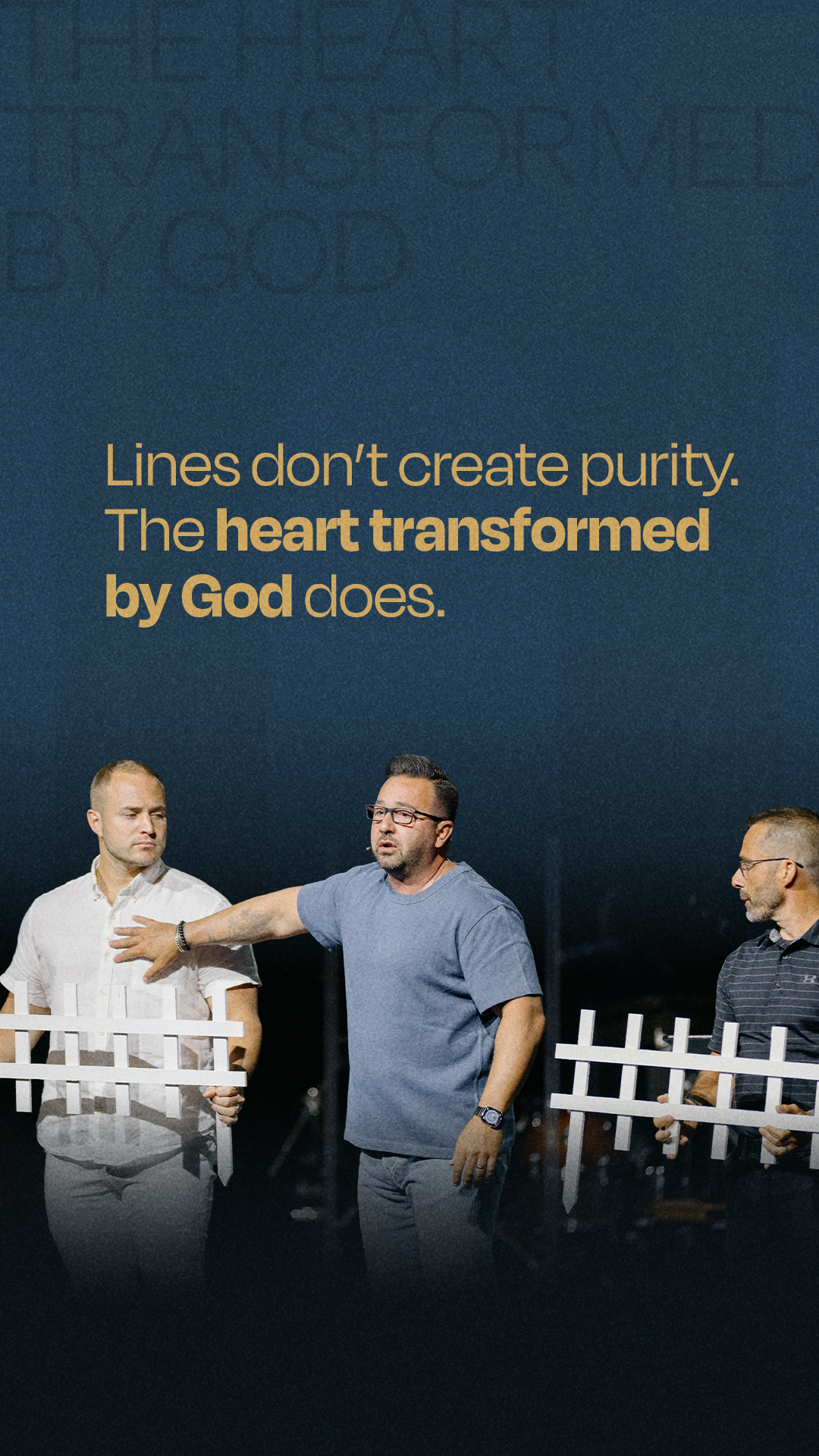
See, this is where many of us, where we get purity wrong. We think purity is the result of protection. We think if we just draw the right lines, if we set up the right boundaries, if we build the right fences, then we’ll be pure. But it doesn’t work like that. See, here’s the problem. You might want to write this down. Lines don’t create purity. The heart transformed by God does.
So you can have some fences. Mind handing me that? Thank you, sir. You can have some fences in your life. And hear me, I’m not going to tell you not to have boundaries in your life, not to have some lines in your life. You can have some strong fences and still have a wandering heart. You can have some strict boundaries and still desire sin. You can have the accountability software and still be addicted in your soul. And the sad thing is, is I see people and they go, “No, no, I just need bigger lines. I need more people in my life. I need more stuff.” And what they’re fighting is a heart that’s opposite of the boundary.
Guys, come on up and help me out real quick, would you? I want you to catch this. I want you to catch this. Because the lines that you put up in your life, more up here, are only good if your heart is pure. But if your heart is dark with sin, somebody help me. What good is this? Because I’m going to tell you what this guy is fighting right here. What this guy is fighting is he’s fighting his heart and he’s fighting this line at the same time. He’s trying to fight the world and fight his own heart at the same time. And when you fight your own heart and you fight the world, you’re going to fail.
Because the line, it’s only as good as the heart. And so many of us, we think we’re pure. We think we’re pure because we’ve got some boundaries in our life, because we’ve got some lines in our life, because our grandmother, our grandfather, some mother’s friend’s, uncle’s best friend told us that if we lived like this, we would be okay. No, it’s the heart. And this lets us come into church with our church face, like everything’s okay. Because our kids look right and social media looks right and everything looks right. But the heart is far, far from him.
Get this, a fence. A fence can make a boundary. But it can’t purify our heart. Did you catch that? The fence can make the boundary. It can’t change the heart. See right here, the heart. This is where the lines get strong. See, the purpose of the line is to preserve what the heart already is, not create it.
And this is where we go wrong. We say, if I just have the right lines, if I just have the right rules in my life, if I can just do everything the right way. And we look at someone, he’s not here today, he’s watching online. He texted me last night. We look at somebody like Pastor Ken and say, 50 years in ministry, faithful to his wife, faithful to the church, faithful to the Lord. And we go, what rules did you live by? I’m going to tell you what, the rules don’t matter. You talk to the man. Flawed? Yes. Because he’s made out of the same thing as you and I, but you talk to the man, the man loves God.
And we get so focused on somebody’s lines rather than their heart for God. And I’m going to tell you, when we get focused on the lines, the problem is this is our heart.
Now I want you to catch this. All right, teens, your parents are right when they tell you to have this line. So, well, if it’s just the heart, then I don’t need any lines. I don’t need any fences. No, your kids, you need lines. You need fences. Hey, parents, but shame on us if we only ever teach the lines. Hey, teach your kids how to have a heart for God. So, well, that’s the youth pastor’s job. I’m really excited about the youth pastor that we’ve got coming here. He’s a great guy, but the best youth pastor in America is a dad who has a heart for God, a mom who has a heart for God. Who has a heart for God. He said, well, I don’t know how to teach purity. Hey, if you can’t teach your kid the heart for God and then putting up the lines, I’m going to tell you what the problem is. It’s this, because you’re putting all of your confidence here. You’re putting all of your confidence here and your heart isn’t here. And if you say, well, you know, if I just take my kids and I drop them off at youth group, I take my kids and drop them off in Kid City and I do that once a week, then they’re going to turn out for Jesus. Listen, you’re investing more in your children when it comes to soccer than you are Jesus and you want them to turn out. No, no, no, no. It’s got to start at home and it’s got to start with your heart and it’s got to start with your devotions and it’s got to start with you teaching your children how to pray and how to worship God and how to follow after God and how to live for Jesus. And hey, if you can’t do that, I’m telling you what the problem is. It’s this. The problem is that we get so fixated on what we think the boundary is that we forget the God that we’re supposed to love and worship and walk with.
Let me get back to my notes. Hey, single people, purity of heart isn’t just waiting for marriage. It’s loving Jesus more than you love sin. Hey, married people, marriage doesn’t need marriage doesn’t need a bunch of lines for purity. What it needs, it needs a pure heart that your spouse never has to compete with. But they never have to compete with pornography, emotional affairs, secret conversations, divided affections. Because when your heart fully belongs to Jesus, it faithfully belongs to your spouse.
Hear me, the line of purity, it’s kind of like the lines on the road. Lines don’t make you a good driver. It just lets you know when you’ve gone too far because the reality is this doesn’t make this pure. And the reason we know is because when the world comes in and pushes against this fence, it falls. And if you’ve been in church any amount of time, if you’ve been a follower of Jesus any amount of time, you’ve seen this happen in people’s lives. You’ve seen it happen in your life.
Guys, thanks. I appreciate this. Thank you. To be honest with you, sometimes I think I’m doing well. Sometimes I think my heart is pure and I’m doing great. But you know what I realized? If the heart isn’t pure, the lines that I draw will always be compromised. Because if my heart isn’t pure, then what kind of lines am I drawing in my life? Hear me, if the heart isn’t pure, nothing’s pure.
Psalm 101 is a psalm of resolve. It’s David saying repeatedly, “I will, I will, I will.” But underneath every commitment is a deep desire for God Himself. That’s what David’s saying throughout the entire thing. That’s what makes the truth of this psalm so different from moralism. David isn’t trying to become a better person. David’s trying to become a man after God’s heart. He wants a heart that delights in God. And from that delight flows integrity. Integrity in his heart, integrity in his home, integrity in his eyes, integrity in all of his relationships, integrity in everything that he does.
Because purity isn’t ultimately about what we are running from. It’s about the God that we’re running towards. And the closer that you walk with God, the more we begin to hear. Hate what dishonors Him and love what pleases Him. If you didn’t get anything from the message today, I want you to catch this. Purity, purity is not the goal. God is. Hey, when your goal becomes purity, when my goal becomes purity, we’re missing something. Purity isn’t the goal. He is. Knowing Him, walking with Him, having a relationship with Him, where He changes you and He changes me from the inside out and He molds us and shapes us.
Maybe you’re sitting here today and you’re going, “Anthony, if you knew me and if you knew how dark my heart was, you would say there’s no chance of me being pure. There’s no chance of God changing me and molding me and shaping me. I’m telling you, it’s impossible.” No, it’s not. He can change anyone. But He does it, piece by piece, day by day, moment by moment, where you and I start looking less like us and we start looking more like Jesus.
Heavenly Father, thank You, Lord. Thank You for Your Word. Thank You for this truth. Lord, this truth, it isn’t deep. It’s very simple. Lord, that all we have to do is just fall in love with You. Lord, would You help us as a church body? Would You help us as individuals? Lord, would You help me to see this and to walk in this truth? Pray in Jesus’ name.