Watch message
When You Don’t Know What to Do Next

Share message
Link Copied
Key Scripture
Transcript
Well, good morning, church. My name is Cory, and I get to serve as the executive pastor here at Northwest. And this morning, I am grateful and privileged and honored to open up this series in the Psalms.
And during this series, you’re going to be hearing from myself, Pastor Anthony, Pastor Matt, and some others as we preach through various Psalms. And I’m really looking forward to this series because last fall, moving into the spring, I was spending my morning quiet time reading through the Psalms. And it was each morning that I got to spend time with Jesus and I got to journal and take some notes and I began to pray through the Psalms.
And so I grown to love the Psalms more and more in this latest season of life because of how relatable they are. And they’re relatable because some seasons of life for us, they’re really hard. Other seasons of life for us, they’re great. But I think most of the time, most of the time we’re living somewhere in between. And that’s where I think we can find encouragement in and through the Psalms, regardless of what stage of life we’re in or season we’re in, the Psalms are this collection of honest and real conversations with God. They are prayers and they are poems and they are written by people who were hurting and celebrating and doubting and hoping.
And what’s refreshing is that the writers of the Psalms, they are honest as they write. They’re honest in their joy. They’re honest in their worship. They’re honest in their pain and they’re honest in their questions. And so something I want us to catch right away as we begin today is that if those who wrote the Psalms can be real with God, so can you and I. Which means we can lean in during this series that we, just like the Psalmist, have permission to come to God just as we are right where we are.
Because here’s what lies at the heart of the Psalms. Every writer, every emotion, every hard season, they all find their way back to the same truth. And this is gonna be our big idea for today. We’re gonna put it up on the screen. It’s there in your notes. And this truth is this, is that when life is uncertain, confusing, or hard, God does not just offer comfort, He offers Himself. And the posture that He asks for is not more effort but surrender. As you’re kind of filling that in and writing that in, let me make that more personal for us, right? Hey, when your life is uncertain, when your life is confusing, when your life is hard, God does not just offer you comfort, He offers you Himself. And the posture that He asks for from you is not more effort from you but surrender.
And so with that in mind this morning, we’re gonna take a look at Psalm 25. So if you’ve got your Bible or your Bible app, I want to invite you to find Psalm 25 with me. And as you’re making your way there, let me give you just a brief overview of Psalm 25. It is written by David. It is a prayer, but it’s not the kind of prayer most of us are used to. It’s not a prayer that’s polished, it’s not kind of that Sunday morning prayer where everything’s neat and tidy and all buttoned up. David is writing the Psalm in the midst of genuinely difficult circumstances. There’s enemies that are threatening him, his own past failures are weighing heavy on him, and he’s unsure about what to do and where to go next.
And I don’t know about you, but when life gets crazy for me or it gets difficult, like David in this Psalm, my instinct, right? My instinct is to catalog everything that’s going wrong. My instinct is to run the list, it’s to assess the damage, it’s to tackle things in my own strength. And then somewhere down the road, I’ll eventually bring God in. I think all of us have found ourself there at one point or another. But what we’re about to see in this Psalm is that David flips that approach around.
So we’re gonna walk through this Psalm together, and for the sake of time, we’re gonna break Psalm 25 down into four different movements, because David is doing something very intentional here, and once we see the structure of this Psalm, the application for us later becomes much clearer.
So let’s begin in verse one together. David writes, “Lord, I appeal to you, my God, I trust in you. Do not let me be disgraced. Do not let my enemies gloat over me. No one who waits for you will be disgraced. Those who act treacherously without cause will be disgraced.”
So here’s what I want us to notice really quick right off the bat. David does not start with his problems. He starts with God. Before David says a single word about his situation, his enemies, his sin, his confusion, his lack of understanding, he establishes the direction of his soul. He says, “Lord, I appeal to you.”
Now let’s break that down for a second, because I think we can read past that too quickly. Here’s what’s amazing in verse one. “The word used for Lord is Yahweh, which comes from the Hebrew word, I am, and it speaks of the self-existence and the self-sufficiency of God. But Yahweh is more than just a description of or for God, it’s personal. It describes a personal God who covenants with and keeps his promises and leads his people forward.” And that phrase, I appeal to you, or as some translations put it, lift up my soul, is a Hebrew way of describing a total orientation towards something. It’s the idea of your whole self. It’s the idea of all of your desires. It’s your will and your attention, all surrendered and submitted, pointed in one singular direction, and in this case with David, toward God. And that orientation that he sets right off the bat carries into verse two, where David says, “My God.” Again, very personal there. He says, “I trust you.” And in verse three, the idea of waits for you, check this out because this is so cool, it’s not passivity. It’s not doing nothing. Rather, it’s active service. The waiting here is not the idea of sitting in a waiting room and doing nothing. Rather, it’s that of a waiter attending to every desire and need of the one being served.
And so with those things in mind, here’s what I want us to catch. David does not say he feels like trusting God. He says he is trusting God. Those are not the same thing. And I think a lot of us have gotten tripped up here because we wait for the feeling most of the time, don’t we? Before we make a move toward God.
I think sometimes we treat God like a thermometer, right? Kind of trying to check the temperature of our faith before trusting him. But what David models here is a trust that is more like a compass rather than a thermometer. David actually sets the direction. He says, “I’m gonna orient myself toward God.” And then he starts walking even before the feeling catches up.
One of the best ways I can think of describing this for us is to think about a parachute for a moment. You can believe in how a parachute works. You can have knowledge about the parachute. You can study the engineering of a parachute. You can examine the stitching of the parachute. And you can come away completely convinced intellectually that it will open up and that it will hold you. But until you step out of the plane, none of that belief has actually done anything for you.
And here’s what I want us to notice, right? Stepping out of the plane is not what saves you. The parachute does that. Your effort does not hold you up. The parachute does. But you have to step out of the plane. You have to act on what you believe. That’s what trust looks like. It’s not manufactured confidence. It is not white-knuckling your way to a feeling. It’s taking the step. It’s orienting yourself toward God, lifting your soul toward Him, and letting Him do only what He can do from there.
That’s what David is doing in these opening verses. He is not generating his own faith in verses one through three, rather he is stepping out of the plane. He’s saying, God, I don’t know how this ends, but I’m putting my full weight on you. Right in the middle of all of his difficulty, David is surrendering his life, telling God I’m personally engaging with you. I’m actively pointing myself toward you, and I’m trusting you.
So here’s what this means for you and me. It means that when life gets hard, when life gets hard, the first question is not how do I feel about this. Rather, the first question is where am I pointed? So let me give us the first of several key points this morning, and here’s this key point. Start with direction, not feelings. Start with direction, not feelings. This is where David starts in the first three verses, then in verse four, after setting his direction toward God, he makes his request.
Look at verse four with me. He says, make your ways known to me, Lord, and teach me your paths. Guide me in your truth and teach me, for you are the God of my salvation. I wait for you all day long. Remember, Lord, your compassion and your faithful love, for they have existed from antiquity. Do not remember the sins of my youth or my acts of rebellion, in keeping with your faithful love, remember me because of your goodness, Lord. The Lord is good and is upright, and therefore shows sinners the way. Verse nine, he leads the humble in what is right and teaches them his way. All of the Lord’s ways show faithful love and truth to those who keep his covenant and decrees.
Here’s what jumps off the page in these verses, at least for me. David here says, make your ways known to me. He says, teach me your paths. He says, guide me in your truth and teach me your truth. David does not lean on his own wisdom for the direction of his life. Rather, he’s asking the Lord for guidance. His prayer honors the counsel from Proverbs three, five, and six to trust in the Lord with all your heart and do not lean on our own understanding, right? That in all of our ways, we’re to acknowledge him, that being God, and he will make straight our paths. Furthermore, David here does not ask God to fix his situation. His prayer request is for God to teach him and to lead him and to show him. To show him what? To show him God’s way or God’s path forward. In Psalm 25, David uses the word way four different times and he uses the word path twice. And here’s why that’s important. Because David understands and he recognizes that life is a journey and not just a single step. And this is why that matters for you and I. Because most of us, when we’re in a hard season, we want relief. We want the situation to change. We want the one step solution. And that’s understandable because we’re human, right? But David here asks for something different. He’s asking for wisdom for the journey, not removal from it. Did you catch that? Say it again. He’s not asking for wisdom or he’s asking for wisdom for the journey, not removal from it.
And in his desire for this wisdom and guidance, David asked God in verse six, he says, “God, remember your compassion or your mercy,” as some translations put it. He says, “Remember your faithful love which has existed since all eternity and it’s part of your nature and your eternal attributes.” And what’s so interesting, verse seven, “Immediately after David asked God to remember those things, he asked God not to remember some things. David wanted God to no longer remember his youthful sins.” David’s repenting here. “The words do not remember are a plea for pardon and for forgiveness. He is not asking on the basis of his own merit but on the basis of God’s mercy. He wanted God to do the remembering and God to do the quote unquote forgetting because of God’s own goodness, not for David’s supposed goodness.”
And David continues this thought right into verse eight saying, “The Lord is good and the Lord is upright. Therefore he shows sinners the way.” And I think we gotta pause here for just a second because there’s something so moving right here. Logic would say that a perfect and a sinless and a holy and righteous and just God should distance himself from sinners like David and like you and like me. He should distance himself from us. He should judge us sinners. He should punish us. He should even destroy us sinners. But what David had learned through experience is that God’s love is more than logic. He learned that God is good and God is merciful and this goodness and mercy are for the benefit of sinners and for our salvation instead of our destruction. That’s why David says in verse nine and 10, God leads the humble in what is right and that God teaches us sinners his ways and that all of God’s ways show faithful love and all of God’s ways show truth.
And I just wanna point something out here. That word humble in verse nine, humble does not mean quiet or soft spoken. It means teachable. It means correctable. It’s someone who comes with open hands to God instead of a predetermined plan.
And so here’s the tricky part and I really wanna just be straightforward with us on this. Myself included but a lot of us approach God more like a GPS that we have programmed with our destination rather than treating God like a guide that we’re actually following. We enter our destination. We know where we want to end up in the end and we’re just hoping God will kinda recalculate the route in the easiest way possible if we’re honest to get us where we want to be. But that’s not what David is doing here. He’s saying, God, I don’t know the destination. I don’t know the path but please teach me, lead me, guide me and that’s an entirely different posture altogether.
And David isn’t talking about a one-time thing here or a one-time prayer request. Back in verse five when David says, “I wait all the day long.” That phrase carries the idea of a sustained orientation, a whole posture of life, not a singular moment of desperation.
And so here’s the key point I want us to take away from this section of Psalm 25 and it’s this. What we actually need is God’s guidance. I know it’s kinda cut off there. What we actually need is God’s guidance, not just relief. What we actually need is God’s guidance, not just relief. So we start with direction and not feelings and we need God’s guidance, not just relief.
And then as we move to verse 11, here’s where David gets really honest. And I appreciate this about him because this is the part of the Psalm where a lot of us would want to skip ahead. And he says in verse 11, he says, “Lord, for the sake of your name, forgive my iniquity, for it is immense. Who is the person who fears the Lord? He will show him the way he should choose. He will live a good life and his descendants will inherit the land. The secret counsel of the Lord is for those who fear him and he reveals his covenant to them.”
Scripture describes David as a man after God’s own heart. Yet David still knew he was a sinner whose load of guilt was heavy or immense like he says here. And at the same time, David knew who God was. And it’s as if David is saying here, “God, I know that I am a great sinner, but I know that you are even a greater savior. I humbly submit myself to you, asking you God for forgiveness.” You see, there’s that realness and that honesty that comes through in the Psalms. That’s just so refreshing.
And in these verses, don’t miss what David does. He does not minimize his guilt. He admits his sin is great. He does not explain it away or try to rationalize it. He just confesses it. And then he points to something or rather someone outside of himself, that being God as the basis for his forgiveness. I love how David says, “For the sake of your name, God.” There’s that humility again. He’s saying, “You, God, not for my sake, because I’ve just been pretty good lately.” He’s saying, “But for your namesake, because of who you are, God.” Y’all, that’s spiritual maturity right there.
And let me explain what I mean by that. If you’re like me, we tend to approach confession like a transaction. We did something wrong. We feel bad about it. We apologize. And then we expect things to go back to normal. But what David understands is that forgiveness is not grounded in how sorry you and I feel. Rather, it’s grounded in God’s character, in God’s promises, in his mercy, and in his grace, and that’s what makes forgiveness reliable. Not the quality of our remorse, but the consistency of his nature.
And with that in our mind, now look at verse 14 with me because this is so cool. He says, “The secret counsel of the Lord, which has also translated the friendship of the Lord.” This carries the idea, these words carry the idea of familiarity, of being brought into an inner circle, of being part of a select fellowship. It is being brought to someone in confidence. Check this out, who knows the whole picture of what’s going on.
Now here’s the seriousness of this, and here’s what I want us to understand. In verse 14, David is letting Christians know the kind of closeness, the kind of friendship, the intimacy with God that he’s talking about here, it’s not available to people who are pretending. Here’s what I mean by that. It’s not that God rejects people who struggle. It’s that we cannot receive deep intimacy with him while keeping things hidden in our lives. The distance we feel from God at times is not God moving away from us, it’s us moving away from God because it’s us, right, managing the distance because we have not dealt with something because we’re holding onto our sin, we are enjoying our sin, or we are hiding our sin.
Here’s how I want you to think about it. Think about a close friendship you have, a real one, where someone did something wrong and neither of you have ever addressed it. Now you can still hang out, and you can still have conversations, but there’s just this thing between you, and you both know it, and it shapes every interaction even if you never say it out loud. That’s what unconfessed sin does in our relationship with God.
And so here’s the key point I want us to take away from this is that unresolved sin creates distance we did not mean to create. Unresolved sin creates distance we did not mean to create because we don’t want to be far from God, we want to be close to him. That’s what that statement means.
So here we are, I just want to do a quick pulse check because like I said at the beginning, we’re breaking this Psalm into four different movements. And so so far we’ve got verses one through three where David sets the direction of his life toward God. And then in verses four through 10, he’s asking for guidance, not relief. And then in verses 11 through 14, he’s dealt with and dealing with his sin and his distance from God.
And so let’s go into the final movement of this Psalm. And what I want you to see is what David does as he closes things out. Verse 15, he says, “My eyes are always on the Lord, for he will pull my feet out of the net. Turn to me and be gracious to me for I am alone and afflicted. The distresses of my heart increase. Bring me out of my sufferings. Consider my affliction and trouble and forgive all my sins. Consider my enemies. They are numerous and they hate me violently.” Verse 20, he says, “Guard me and rescue me. Do not let me be disgraced, for I take refuge in you. May integrity and what is right watch over me, for I wait for you. God redeem Israel from all of its distresses.”
In this last movement, notice where David’s posture lands. He says, “My eyes are always on the Lord. That posture right there, eyes fixed on God, is so important for us to see.” Because at this point in the Psalm, things have not been resolved. It’s still difficult for David. Nothing has gotten better. Actually, as he prays here and he talks to God, he’s sharing with God, hey God, things seem to actually be getting worse. Look at what he said. He said in verse 16, “I am alone and afflicted.” In verse 17, he says, “The distresses that is plural,” and he says, “The distresses of my heart are actually increasing.” In verse 19, he says, “My enemies are numerous and they hate me violently.” No resolution. Y’all, David’s not closing up this Psalm here and going, “Hey everybody, everything got better and I just lived happily ever after.” Rather, and don’t miss this, he closes with sustained trust. Sustained trust, look again, verse 15, he says, hey God, it’s gonna be you who will pull my feet out of the net. In verse 16, he says, “God, it’s gonna be you who will bring me out of my suffering.” Sustained trust, right? Verse 18, God, it’s gonna be you who forgives my sins. Verse 20, he says, “God, it’s gonna be you who will guard me and rescue me.” And in verse 21, he says, “God, it’s gonna be you who I wait for.” Sustained trust, eyes always on the Lord.
And here’s what I want us to understand is that God will not always change our circumstances, but what God does consistently and faithfully and reliably is give us what we need to navigate them. You might say, why does he do that? How can God do that? He can do this because he sees the whole picture. He’s not just looking at today. He’s not just looking at this, just this season of life. He’s looking at the whole arc of your life and mine. And this is so important for us to understand and grasp because sometimes we evaluate God’s faithfulness based on a very short and small window in our lives. You and I many times are just looking at this week and this month or this year. And we ask, right, where is God in this? But God is working across decades and across generations in ways that we cannot see from where we’re standing.
And somehow David gets this. You say, well, how does David get this? He understands this because look at how he closes out the Psalm in the last verse. He says, God redeemed Israel from all of its distresses. Here’s what’s so cool. This last verse shows us that David zooms out. He zooms all the way out. He removes himself from the personal situation he’s in to the whole people of God. David understood and he reminds us that what God is doing is bigger than any one person’s story, that our story is part of a much larger picture.
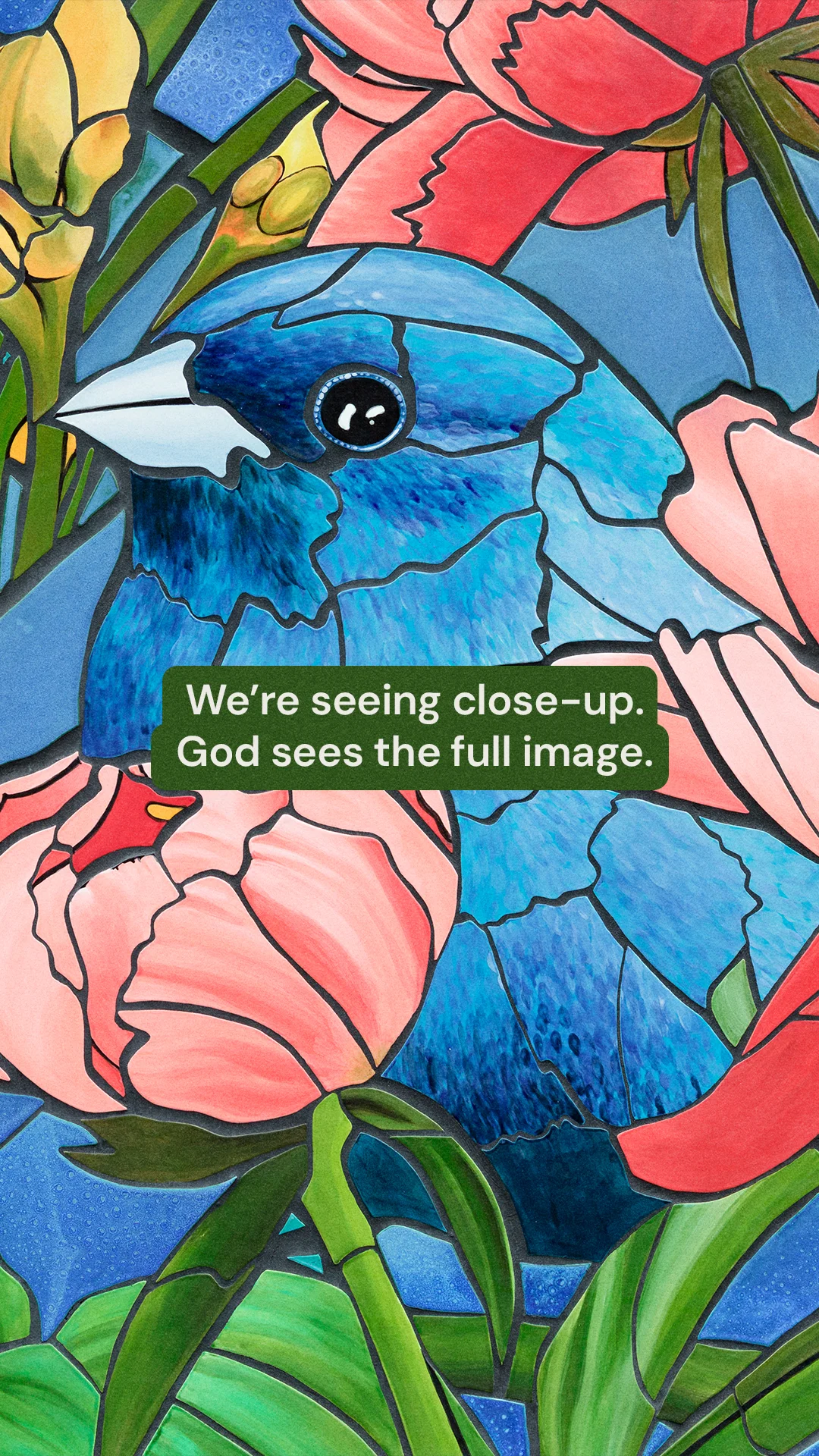
And here’s how I think about it. It’s like standing in front of a mosaic. Check this out on the screen. It’s like standing out. If you don’t know what a mosaic is, it’s kind of where a bunch of little pieces of stuff are put together to create a bigger picture. So it’s like standing in front of a mosaic, right? You can see the tiles, the colors, the shapes are there. The craftsmanship is there. The pieces are there. The details intentional. But the picture’s incomplete, right? From where you’re standing or from what you can see. But when you zoom out and when you step back, you can see the bigger picture. In many ways, this is what faith is like. So often we’re seeing so close up, but God is seeing the full image zoomed all the way out.
And so here’s the key point for us here. God sees the whole picture, even when we only see this moment. So we start with our directions, not our feelings. What we actually need is God’s guidance, not just relief. Unresolved sin creates distance we did not mean to create. And God sees the whole picture, even when we only see this moment.
Now listen, that is a lot of scripture in a short amount of time. But before we wrap up, let’s talk about moving beyond just reading Psalm 25 into actually living it out. That now that we see the structure of this Psalm, like we said earlier, we can now better understand its application.
So I wanna walk us through four practical steps, one from each movement. But here’s what I wanna say and I want you to notice right up front, right? As we go through these, these are not a checklist for you and I to complete once. Rather, they’re a posture that we return to over and over and over again.
So here’s our first practical step, our first application point there in your notes. Set your direction toward God. Set your direction toward God. Before you assess your circumstances this week or the next time difficulty comes, hey, orient yourself. Here’s what I mean by that. Most of us, the teenagers in the room, all the way to the adults in the room. Most of the time, what do we do? We wake up and the first thing we do is we run the list, right, what’s due today, what’s stressful, what’s the kid’s schedules look like, what’s unresolved in my life right now. And we spend the first 15 minutes of our day already behind, already anxious, already in problem solving mode, already moving forward in our own strength. But David has shown us that we need to start somewhere completely different. That before the list starts, before the assessment starts, before the phone and social media and the outside world comes crashing in, we’re to start by setting our direction saying, Lord, I appeal to you. My God, I trust you.
So here’s the step, and I wanna be specific about this because a vague application doesn’t actually change anything. Every morning this coming week, before you do anything else, and of course, I would love for you to wake right up and read your Bible and pray, all right? But before that, here’s what I want you to do. Roll right out of bed or stay under your covers right in bed and just say, Lord, I appeal to you. I lift my soul up to you. And my God, I trust you today. That’s it, 10 seconds y’all, between you and God, because there’s something about saying it that makes it more than just a thought. You’re surrendering. You’re setting the direction of your whole day before all of the noise comes in. And let’s just be honest, right? You know it just as well as I do, but the days I don’t orient myself and I don’t set my direction toward God and surrender toward him, here’s what happens, right? I end up navigating things entirely on my own until I am exhausted and I am anxious and I’m living in my own strength and I’m in trouble. And then all of a sudden God becomes a 911 call instead of someone who’s actually guiding my life from the start. So David shows us a different way here to start by setting our direction toward God.
Next, open your hands. Open your hands. And here’s the one that is probably gonna be the most uncomfortable for all of us. So we’re just gonna hit this head on. I’m asking for all of us to identify one specific area in your life, don’t miss this, where you have been telling God where you want to end up rather than asking him to lead you. A relationship, a career decision, a life decision, a school decision, something for your kids, a financial decision, something you’ve been holding onto with a closed fist, hoping God will bless what you have already decided. I want you to take that one thing this week and bring it to him and open up your hands. And like David, begin to say, God, I don’t know where this is gonna end up, but make your ways known to me. Teach me your paths. Guide me in your truth. Teach me your truth. And hey, just as a reminder, all of these things, right? God’s truth, God’s paths, all of these things are in God’s word. That’s why Psalm 119 says, your word is a light to my feet and a lamp to my feet and a light into my path. But I want you to just take that one thing today and open up your hands.
But this is genuinely difficult for us because letting go means the outcome is no longer guaranteed. And y’all, it’s as if the outcome was guaranteed to begin with, it wasn’t. But it means, this is why it’s hard, it means you and I might not get what we were hoping for. And that’s especially scary for things that matter deeply to us.
But don’t forget what verse nine says. God leads the humble in what is right. It does not say that he leads the confident. It does not say that he leads the experienced. It does not say that he leads the strongest. It says he leads the humble, the teachable, the one who comes with open hands. And a lot of times I think we get stuck, I get stuck, not because God is not moving, but because we’re holding on to something so tightly that we want, that we’re not actually available to be led by God anywhere else.
So here’s the application. One area this week, open hands, right? One area this week, open hands.
Third practical thing, close the distance. Close the distance. And I’m not gonna assume I know what this is for you, but I guess for most of us, if we’re honest, we have something between God and us that we haven’t fully dealt with. A pattern we’ve normalized, a choice we’ve rationalized, something we’ve just kinda quietly moved around in our relationship with God. And here’s the thing I want you to understand. If that’s you, when that’s you, the distance you feel from God may not be about your circumstances that you’re in. It may be about unconfessed sin that’s creating separation you did not fully realize was there. But like David, repentance is how we close that distance. Not because it earns forgiveness, David makes that clear. He does not appeal to his own goodness. He appeals to God’s goodness. And the basis for coming back is never your performance or my performance, it’s always God’s character. But intimacy requires honesty. And that you cannot receive what God wants to give you while you’re managing unconfessed sin that he already knows about.
So here’s the step. Bring it to him this week. Write it down if that helps you be specific. Don’t dress it up, just repent. Repent the way David models for us. My sin is immense. And then let God’s character, not your performance, be the ground on what you stand for forgiveness in closing that distance. And if you’re not sure where to start, here’s a simple question to ask yourself. What’s the one thing I’ve been avoiding bringing to God? And then like it says in 1 John, just confess it. Like really confess it and know that God is faithful to forgive.
Lastly, trust the big picture. Trust the big picture. This one’s for the person in the room. You’ve been faithful for a long time and you’re still waiting. You’ve been doing the right things. You’ve been showing up. You have been trusting. And the thing you’ve been believing God for hasn’t happened yet and honestly, you’re tired and you’re starting to wonder if you miss something. You’re wondering if God forgot. And you’re wondering is this just how it’s gonna be from here on out? Remember Psalm 25 ends with everything still difficult and unresolved. But David closes with sustained trust. My eyes are always on the Lord. And what I want you to hear in this is this. God sees the whole picture, not just today, not just this season, but the full arc of your life. And he sees beyond your life. And he’s working in ways you cannot see from where you are standing right now.
So here is the step. Take the one thing you’re anxious about. Take the one thing that’s been weighing on you. One specific thing. And I want you to write it down. And after you write that one thing down, I want you to write underneath it. God sees the whole picture. I trust him. God sees the whole picture. I trust him. And then I want you to put that somewhere you’ll see it. Not because the anxiety disappears the minute you write that down. Not because the weight is instantly removed when you write that down. But because sometimes, right, on the hard days, we need a physical reminder that trust is not based on our circumstances being resolved. It’s based on who God is.
So Psalm 25 is not just a prayer. Rather, it’s a framework to orient ourselves, to open our hands, to close the distance, and to trust that big picture. Remember, these aren’t four separate things we do once. And check off a list. They’re a rhythm. They are a posture of life. They’re what it looks like to actually live in relationship with God rather than just believing things about him. So as you ponder the application, wherever you find yourself, just start there.
And I close with this as I was thinking through this Psalm. This is so awesome for you and I today. It’s what brings this Psalm really close and relevant to us, to you and I today. Everything David is asking for in this Psalm, hey, guidance, forgiveness, intimacy, protection, check this out, don’t miss this for you and I. All of it finds its fullest answer in Jesus Christ. Jesus is the path. Jesus is the way. Jesus carries all of the guilt. Jesus brings us into the inner circle with God and Jesus plucks our feet from the net.
So if you’re here today and you’ve never personally trusted in Jesus, this Psalm is actually an invitation for you. Not just to pray better, not just to manage life more skillfully, but to enter into a real relationship with God who knows your whole story, loves you, extends grace, extends mercy, offers forgiveness and offers a relationship with him through Jesus.
And if you’re a follower of Jesus today, this Psalm is a recalibration for us. It’s a reminder of the posture we’re to have day in and day out. And it’s an invitation for us to trust our heavenly Father because when life gets confusing, uncertain and hard, God does not just offer comfort, he offers himself to you and I. And the posture he asks for is not more effort from us, rather surrender.
So here’s what I wanna do as we close out our time together. I wanna ask, would you bow your heads right now? And let’s just have a few moments of quiet. And silence. And I wanna give you some space right now before we leave to come to your heavenly Father because for someone in the room today, it’s time for you to set your direction toward him. For others in the room, it’s time for you to open up your hands with something you’ve been holding onto you. Some you need to close the distance and repent. Some of you need to trust God with the big picture. Whatever it is right now in this silence, talk to him, bring it to him.
With our heads still bowed, still in this moment, let me read Psalm 25 one more time. (gentle music) And may it land differently than when we walked in this morning. Lord, I appeal to you. My God, I trust in you. Do not let me be disgraced. Do not let my enemies gloat over me. No one who waits for you will be disgraced. Those who act treacherously without cause will be disgraced. Make your ways known to me, Lord. Teach me your paths. Guide me in your truth. Teach me for you are the God of my salvation. I wait for you all day long. Remember, Lord, your compassion and your faithful love, for they have existed from antiquity. Do not remember the sins of my youth or my acts of rebellion. In keeping with your faithful love, remember me because of your goodness, Lord. The Lord is good and the Lord is upright. Therefore, he shows sinners the way. He leads the humble in what is right, and he teaches them his way. All the Lord’s ways show faithful love and truth to those who keep his covenant and decrees. Lord, for the sake of your name, forgive my iniquity, for it is immense. Who is the person who fears the Lord? He will show him the way that he should choose. He will live a good life, and his descendants will inherit the land. The secret counsel of the Lord is for those who fear him, and he reveals his covenant to them. My eyes are always on the Lord, for he will pull my feet out of the net. Turn to me and be gracious to me, for I am alone and afflicted. The distresses of my heart increase. Bring me out of my sufferings. Consider my affliction and trouble, and forgive all my sins. Consider my enemies. They are numerous, and they hate me violently. Guard me and rescue me. Do not let me be disgraced, for I take refuge in you. May integrity in what is right watch over me, for I wait for you. God redeem Israel from all of its distresses. And all of God’s people say, amen.