Watch message
When Your Soul Starts Lying to You

Share message
Link Copied
Key Scripture
Discussion Questions
Message Highlights
- When we’re stuck, the loudest voice telling us “I’ll never be happy again” is our own. It’s the most convincing voice we hear, and the least reliable.
- In Psalms 42–43, a worship leader struggling to worship talks back to his soul three times with the same truth: put your hope in God. His situation doesn’t change, but by the end he calls God “my greatest joy.”
- When your soul starts lying to you, respond with what God has said: question it, answer it, and repeat it. This isn’t self-help. God uses his truth to lead us out, one truth at a time.
Conversation Starter
- Where does your mind do the most talking: in the car, in the shower, or at 2am staring at the ceiling?
- What’s a song you’ve sung so many times you could do it in your sleep, without ever stopping to think about what the words meant?
Core Discussion Questions
Connection Question: What stood out to you from this week’s message about the things we tell ourselves when we’re stuck?
Context Question: Where have you encountered Psalm 42 before (maybe the “As the Deer” chorus), and what picture did you have of it? How did verse 3, “My tears have been my food day and night,” change that picture?
Clarity Question: The psalmist calls God “my rock” and asks “why have you forgotten me?” in the same breath (Psalm 42:9). How did this week’s message change your perspective on what honest faith can sound like?
Application Question: What’s one lie your soul tends to repeat when life gets hard? What’s one thing God has said that you can use to answer it this week?
Additional Questions (Optional)
- The psalmist said the right words and, in the very next line, still said “I am deeply depressed” (Psalm 42:6). Why do you think it matters that the Bible doesn’t hide that?
- “A lie has a lot more power when nobody questions it.” Where have you seen that be true?
- Nothing around the psalmist changed. What changed was whose words he was listening to. Whose words do you tend to listen to most when you’re stuck?
Personal Study
Exploring the Scripture
Main Scripture: Psalms 42–43
Psalm 42 opens Book II of the Psalms, and it’s the first of several psalms credited to the sons of Korah. They were Levites, a family that served in the temple, including as musicians and singers. That makes this the song of someone who used to lead the crowd into God’s house with joyful shouts (42:4) and now can’t get there. Most scholars read Psalms 42 and 43 as one song: Psalm 43 has no heading of its own, the same refrain runs through both, and many Hebrew manuscripts join them together.
The psalm is a lament, a form found throughout the Psalms, in which God’s people bring their grief and complaints directly to him. The writer mentions the land of Jordan, the peaks of Hermon, and Mount Mizar (42:6), places in the far north, a long way from Jerusalem. We can’t know for sure whether that’s where he was writing from, but he’s clearly far from the house of God and feels the distance. People around him keep asking, “Where is your God?” (42:3, 10), which is the same question he’s already asking himself.
What makes this psalm unusual is that the writer talks to his own soul. Three times he asks, “Why, my soul, are you so dejected?” and three times he answers with the same instruction and promise: “Put your hope in God, for I will still praise him” (42:5, 11; 43:5). In between, he names the waves crashing over him as God’s own breakers and billows (42:7), the same words Jonah prayed from inside the fish (Jonah 2:3). He also uses God’s personal name, the LORD, for the only time in the two psalms, right in the middle of the storm (42:8).
The turn comes in Psalm 43, when he asks God for what his own voice can’t give him: “Send your light and your truth; let them lead me” (43:3). The song ends with him still far from home, but now calling God “my greatest joy” (43:4). Jesus would later call himself the light of the world and the truth. In Gethsemane, his words “My soul is swallowed up in sorrow” closely echo this psalm’s refrain in the Greek Old Testament his first hearers knew.
Questions for deeper study
- Read Joel 1:20, the only other verse that uses the Hebrew word for “longs” from Psalm 42:1. How does that change the way you picture the deer?
- Compare Psalm 42:7 with Jonah 2:3. What does it mean that both writers call the waves God’s waves? Is that comforting or troubling to you?
- In Psalm 42:8, God’s personal name shows up in the middle of the psalmist’s worst moment. What does that suggest about where God is when you feel farthest from him?
- The psalmist’s soul asks “why?” and he answers with “hope in God.” Why do you think he doesn’t answer with an explanation of his circumstances?
- Read Psalm 43:3–4 alongside John 8:12 and John 14:6. How does Jesus answer the psalmist’s prayer for light and truth?
- Read Mark 14:34. What does it mean to you that Jesus knew this kind of sorrow from the inside?
- Compare the first and last words the psalmist uses for God: “Why have you forgotten me?” (42:9) and “my greatest joy” (43:4). What happened in between?
Deeper Discussion Questions
- Some Christians treat depression or anxiety as a sign of weak faith. How does Psalm 42:6 push back on that? Why does it matter that getting help from a counselor or doctor isn’t a lack of faith?
- What’s the difference between answering your soul with God’s Word and positive self-talk? Where does each one say the answer comes from?
- Repeating a verse can drift into treating it like a lucky charm, as if saying it enough times guarantees the outcome you want. How is the psalmist’s repetition different from that?
- “I will still praise him” is a promise about the future, made while he doesn’t feel like praising. Is it honest to say words of faith before you feel them? Why or why not?
- The psalmist asks God hard questions without being rebuked for them. How does that challenge the idea that faithful people shouldn’t question God?
- Our culture often says, “Trust your feelings” or “Speak your truth.” How does this psalm challenge or complicate that?
- Which of the three lies (“I’ll never be happy again,” “Nothing good can come from this,” “There’s no point in continuing”) sounds most like your own voice? What makes it so convincing?
Living It Out
- Notice the voice. This week, notice when your soul starts talking: in the car, in the shower, or late at night. When you hear one of the three lies, ask the psalmist’s question: “Soul, why are you saying that?”
- Choose your verse. Pick one thing God has said, such as Hebrews 13:5, 2 Corinthians 12:9, or Psalm 34:18. Write it somewhere you’ll see it during the day, and come back to it every time the lie returns.
- Say it with someone. Share your verse with one person from your group or family this week, and ask them to check in with you about it.
- Finish where he finished. At the end of a hard day, before you fall asleep, end with the psalmist’s words: “I will still praise him.” You don’t have to feel it yet.
Prayer Focus
If your own voice has been telling you it will never get better, bring that voice to God instead of arguing with it alone. Ask Him to send His light and His truth to lead you, as the psalmist did. Thank Him that His faithful love shows up by day and His song stays with you in the night, even when you can’t feel it. Ask Him to keep using His Word to change whose words you’re listening to. Close by reading Psalm 43:3–5.
Transcript
What do you do when there’s nothing that you can do? That’s been the theme throughout this series that we’ve been in called Stuck. I don’t know how many of you know this. When it comes to sermon preparation, I’m what I would refer to as a prepared person. I generally write way in advance for all sermons. You say how far in advance. I just finished writing 2027 sermons. Some of you are like, “If that’s weird, what’s wrong with you? If you knew every week that Sunday was coming, you would be prepared too.” Now it’s a mix because my pastor friends are jealous of me. They are like, “I wish I was like six weeks ahead, let alone a whole year ahead.” And then some other people are like, “Listen, how do you let the Holy Spirit talk to you if you’re already decided a year in advance what you’re preaching?” Well, I don’t know. When I read the Bible, forgive me, I read the Bible sometimes, and it says that time isn’t a thing for God. So he leads earlier on and how he leads in the moment. There’s not a difference between the two.
But sometimes God walks me into a scenario thinking I know exactly what’s going to happen and then changes everything on me. And that’s what he did this week. I left Sunday feeling like six weeks of the series just wasn’t enough. I didn’t feel that way a year in advance, but I felt that way. And so I went home and I started thinking about some things, got up Monday and said, “Surely, surely if I go to Pastor Cory, he’ll talk me out of this really bad idea.” And he didn’t. Pastor Cory will talk me out of it and he didn’t. So I sat down and I just started working on some things. And God gave me a message this week that I want to preach to you today.
And the reason I told you all of that is you can have plans and you can have God lead your plans from the very beginning, but it’s not about being willing in the beginning or willing in the moment. It’s about always being yielded to the Holy Spirit. So what do you mean when life takes a turn for the worse? When you’re not sure that life is going to get better? I mean, throughout the entire series, we’ve been talking about three lies that we tell ourselves when we’re stuck that I’ll never be happy again, that nothing good can come from this, that there’s no point in continuing on. And so today I want to ask you a different question.
Who’s telling you things? I mean, when you hear those lies, I’ll never be happy again. Nothing good can come from this. There’s no point in continuing on who’s telling you those things. I’ll tell you who. You. Because you talk to you more than anyone else. They say like, “That’s kind of weird if I talk to myself.” You do talk to yourself. In the car. In the shower. While you’re exercising. I mean, God forbid anyone ever film me while I’m in the gym. Because I’m either worshiping and I’m singing along to some music. I’m preaching whatever I’m going to preach that Sunday. Or I’m talking to myself. And I probably look equally as crazy in all three scenarios.
But you talk to yourself in the shower, in the car, at 2 a.m. staring at the ceiling when you can’t sleep. And when you’re stuck, that voice gets louder. That I’ll never be happy again. That nothing good can come from this. There’s no point in continuing on. It just gets louder. Because no one had to tell me those things. And no one has to tell you those things. I said them to myself and I believed them and you believed you. The reality is, is you’re the most convincing person that you know. And you’re also the least reliable.
Most scholars when they look at Psalm chapter number 42 and 43. They see them as they were originally just one song. The Psalm 43 has no heading of its own. The same chorus, because it’s a song, runs through both of Psalms. And the Hebrew manuscripts actually put them together. The heading says the Psalm is from the sons of Korah who were Levites. Here’s why that’s important. It’s because their family led worship at the temple. And so we’re gonna read about a worship leader who’s struggling to worship. Who’s struggling with the Lord.
Psalm 42 verse number one. You’re probably familiar with this. It says as the deer longs for flowing streams. So I long for you God. I thirst for God, the living God. When can I come and appear before God? I mean we’ve heard the song. We’ve put this verse in a peaceful picture. A deer beside this beautiful flowing stream. But as you read throughout this Psalm you’re gonna notice one thing for sure. That the psalmist under the inspiration of the Holy Spirit as he’s penning these words is not calm. He’s not at peace. He’s in a crisis. And there’s a little bit of a glimpse as to where this Psalm is going because you can see it in the very first verse. This word longs in Hebrews. In the Hebrew it appears in only one other verse in the New Testament. And it’s in Joel 1:20 where animals cry out to God because the streams have dried up. The word longs gives us the understanding that there’s desperation. This isn’t a deer that’s just desiring to go by and drink a little bit of a water just to cool its tongue just to refresh itself. No this is a deer that is desperate for water. The same way the other animals were desperate. This helps us get the urgency of this picture. That this is a thirst that needs to be satisfied.
Psalm 42 doesn’t tell us why the deer is thirsty but it tells us why the psalmist desires God. Look at verse 3. “My tears have been my food day and night all day long. People say to me, “Where is your God?” Do you hear that brokenness? Oh what’s he been eating? Nothing. He’s just been crying. He’s been crying and people have saying to him, “Where is your God?” And there’s this desperation to want to see God work. People keep asking the psalmist what he’s already asking himself. Where is God?
Verse number 4 says, “I remember this as I pour out my heart. How I walked with many leading the festive procession to the house of God with joyful shouts and thanksgiving.” He remembers leading the crowd into the house of God shouting for joy leading the people to worship. That’s the longing he’s describing. God I need you and I don’t understand why you feel so far away. Some of you know what that’s like. He’s talking about remembering leading people to worship. He’s struggling realizing that he’s told everybody how good God is, how great God is, how God is to be worshipped. And now he’s the one that I have been there. You’ve probably been there. I mean last week I talked about how good God is and that we say that God is good regardless of what’s going on and there have been those moments where I’ve said I’ve told so many people in Christ this how good God is and right now I’m struggling to feel it.
That’s where the psalmist is at. It’s not that he isn’t right with God or that he’s done something wrong but there’s something happening in his life where he feels so desperate, he feels so distraught, he’s so discouraged, so depressed that his heart is so heavy that God just feels far away.
And up to now he’s been pouring out his heart and in verse number five he turns and he talks to his own soul. He says why my soul are you so dejected? You’re gonna see that phrase over and over again throughout this psalm. Why are you in such turmoil? Put your hope in God for I will still praise him my Savior and my God. See we read that and we go it’s all fixed. I mean he saw the truth he said hey why are why soul are you so dejected but but why are you in such turmoil but I’m just gonna keep on praising God and everything is going to be okay. Now I want you to watch how the rest of the psalm unfolds but to explain this verse he says soul why are you so down? And he asked his own turmoil a question why? Then he gives his soul instruction put your hope in God and then he makes this promise I will still praise him. Future tense he doesn’t feel like praising right now but he’s still gonna keep praising and he’s telling his soul this isn’t the end.
Look at verse 6 I’m deeply depressed therefore I remember you from the land of Jordan the peaks of Hermon and Mount Mizar. He literally the next line I will still praise him my Savior my God. He still says I’m deeply depressed. It’s the same Hebrew word is dejected in verse number five and he asks his soul why are you cast down? The very next line my soul is cast down. He said the right words and he still feels what he felt. Talking back to your soul isn’t a switch that you can flip and it’s like as you’re reading the passage of Scripture you see this struggle but it’s easy to tell people how to fix their problems and you go listen if you’re just feeling really sad if you just praise God everything will be okay and in this psalm you’re literally seeing how difficult it is to go from one thing to the other and I’m grateful that the Bible tells us this and shows us this.
Sometimes that struggle is difficult and it’s easy to get down on yourself and say well I’ve got Jesus he dwells inside of me and his spirit lives inside of me and empowers me to do that which I can’t do you’re right and sometimes we still find ourselves defeated, struggled, running and feeling heavy and if you find yourself in those moments of depression let me just tell you this because I know some preachers have said this in the past they said well depression isn’t real if you’ve got Jesus then you’ve got all you need no if I’ve got Jesus I’ve got all I need but depression is real and if you’re dealing with depression you’re dealing with some suffering in that area hey it’s not a lack of faith for you to get some help there’s nothing wrong with that.
Here the psalmist reminds himself of this struggle that he’s going through and he remembers God from the land of Jordan the peaks of Hermon and so many people think right now he’s far away while he’s writing but we’re not sure what we do know is he’s nowhere near the house of God. Look at verse number seven deep calls to deep and the roar of your waterfalls all your breakers and billows have swept over me. Now this ought to sound familiar because breakers and billows and wave after wave Jonah prayed these exact words from the belly of the fish. This is how this man feels. He feels like everything is just crashing over him one moment at a time but he still realizes where all of this comes from because look at what he says your waterfalls your breakers your billows he’s still recognizing that God is in control the waves that are drowning him belong to God and Jonah knew this as well and even here he knows who’s in charge of the water he knows who’s in control of everything.
Look at verse 8 the Lord will send his faithful love by day his song will be with me in the night a prayer to the God of my life in the middle of the waves in the middle of the turmoil in the middle of wave after wave your billows your breakers all of this and how he feels in the middle of all of that God’s personal name shows up Yahweh. Now there’s two ways you can know that you can study it out and you can look for it or you can also look in your Bible when you see Lord in all letters that’s Yahweh. This is the Lord interacting in a personal way in his life the faithful love the daytime the song in the night even at 2 a.m. sometimes God has a way of giving you something to sing back to him or for you to know his presence is with you.
Look at verses 9 and 10 I will say to God my rock why have you forgotten me why must I go about in sorrow because of the enemy’s oppression my adversaries taunt me as if crushing my bones while all day long they say to me where is your God and I want you to notice something that was an encouragement to me. I want you to know something in this verse that’s so easy to look past I want you to see something that might be a help to you right now or someday in the future there’s two phrases that are in this verse my rock and why have you forgotten me in fact they’re in the same sentence and he’s leaning on the rock while still asking the rock why it feels so far away that’s honest faith.
Look at verse number 11 why my soul are you so dejected why are you in such turmoil put your hope in God and then Psalm 43 he asked God for something his own voice can’t give he asked God for something that the Psalmist can’t do for himself. Look at what he says in verse number three send your light and your truth.
Hey we ask for a lot of things we ask for our problems to go away we ask for depression and anxiety to lift we ask for our fears to be secured for our finances to grow for our kids to turn out for our marriage to for our job to allow us to be successful. I mean we ask for so many things we say God if you do this everything will be better God if you do this I will be better God if you make this happen life will be easier and in this depression and dejection that the Psalmist feels where his sorrow feels so heavy that he’s talking to his own soul what does he look for what does he ask for because if it was us we would have a laundry list of things to ask for that all have to do with this world and all have to do with the stress and the pain of this life but the Psalmist says send your light and send your truth.
When’s we ask for God to send his light when’s the last time when we’ve told ourselves lie after lie after lie after lie that we’ve asked God to send his truth to us there’s something here that we need the Psalmist realizes it he says send your light send your truth let them lead me we let a lot of things lead us in our worst moments and like the Psalmist his soul is speaking to him right now he’s speaking back there’s a lot of times where we let our own voice lead us yes we might talk to ourselves more than anybody else but we’re also the most unreliable voice that we have and all too often we let our voice our wants our wishes our desires lead us instead of God’s light and instead of God’s truth.
And look how we asked to be led let them bring me to your holy mountain to your dwelling place then I will come to the altar of God to God my greatest joy I will praise you with the lyre God my God.
The Psalmist is asking for light and truth but the light and the truth that the Psalmist is asking for and how he wants to be led it’s not led through the difficulties and it’s not led to success and it’s not led to having all of his wants and his desires and his wishes come true it’s not that he would get a whole bunch of things which is what we’re used to praying for no in his stuck moment what he prays for is that God’s light and God’s truth and God’s leading would lead him right back to God because he’s all that we need light and truth in the dark your soul makes up a lot of stories and your soul can tell you some things there are the moments that we tell ourselves lies and there are the moments that we have imaginary conversations with people in our mind and there are those moments that we define ourselves by our worst moments hey in this moment the Psalmist says lead me to you with your light and your truth it’s all these times that we need God to send us his truth his light to lead us out.
And even with that declaration and even with that truth that is so profound and so helpful for all of us that we could take that and go I need to apply this to my life today look at what the Psalmist says next my soul why are you so dejected why are you in such turmoil put your hope in God for I will still praise him my Savior and my God dejected three different times he’s describing being dejected the song ends and he’s still far away from home situation hasn’t changed but I want you to listen to how he talks at the end of the Psalm Psalm 42 he asked God why have you forgotten me and by Psalm 43 he’s calling God my greatest joy what changed around him nothing what changed is whose words he was listening to.
Too many times we’re looking for everything around us to change we’re looking for everything around us to get better we’re looking for everything around us to bend yield to our desires for us to feel like praising God for us to feel like everything is good hear nothing around him changed what changed whose words he was listening to faith often sounds like saying the same truth again and again and again God uses his truth to lead us out one truth at a time I talked about this last week and I had no intention or plan of telling you that before we sang no there was there was some difficult times where God didn’t feel good where life didn’t feel good the worst moment of me struggling I’m still trying to lead people and tell them that God is good what I found myself doing was saying God’s truth again and again and again and again and again and all too often what happens to us as we look for a book we look for a podcast we look for some video we look for someone around us whose voice is louder than our own voice rather than going to the truth of God’s word and resting in his truth and saying his truth again and again and again and again.
This is why you’re supposed to hide his word in your heart this is why the only time that you open your Bible can’t be when I’m standing on this platform it’s why you’ve got to be a person of the book it’s why we need to be people of the book you’ve got to hide it in your heart you’ve got to know it so that the next time that your voice starts speaking whether you’re in the car you’re in the shower whether it’s laying in your bed at 2 a.m. and you’re staring at the ceiling you’ve got to know the truth of God’s word not just the things you want out of this life and the psalmist the psalmist realized this and it’s what we need to realize.
Say Anthony I get all of that and I want I want to do it but but just don’t know how do what the psalmist did when you hear your voice when you hear that voice.
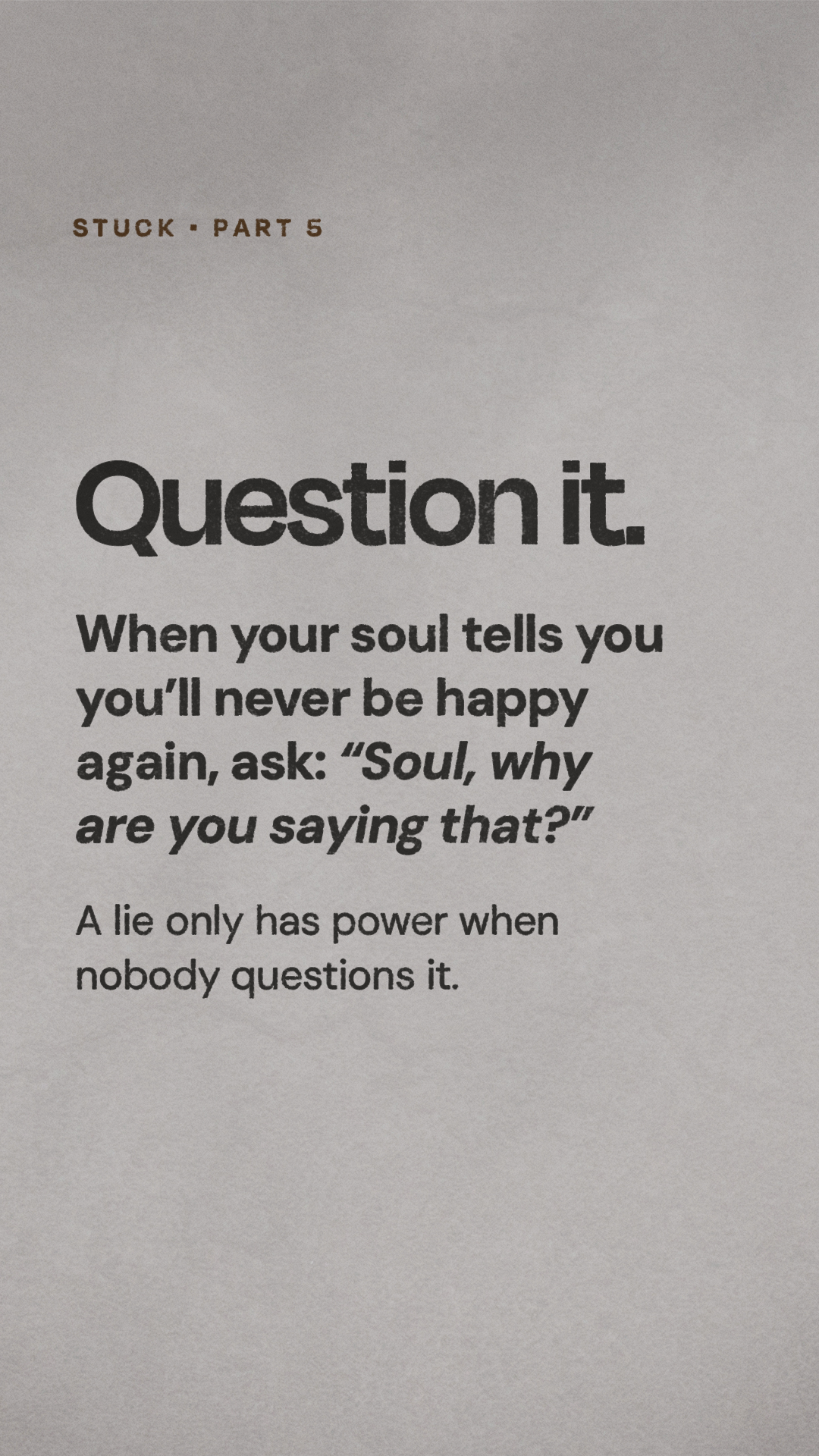
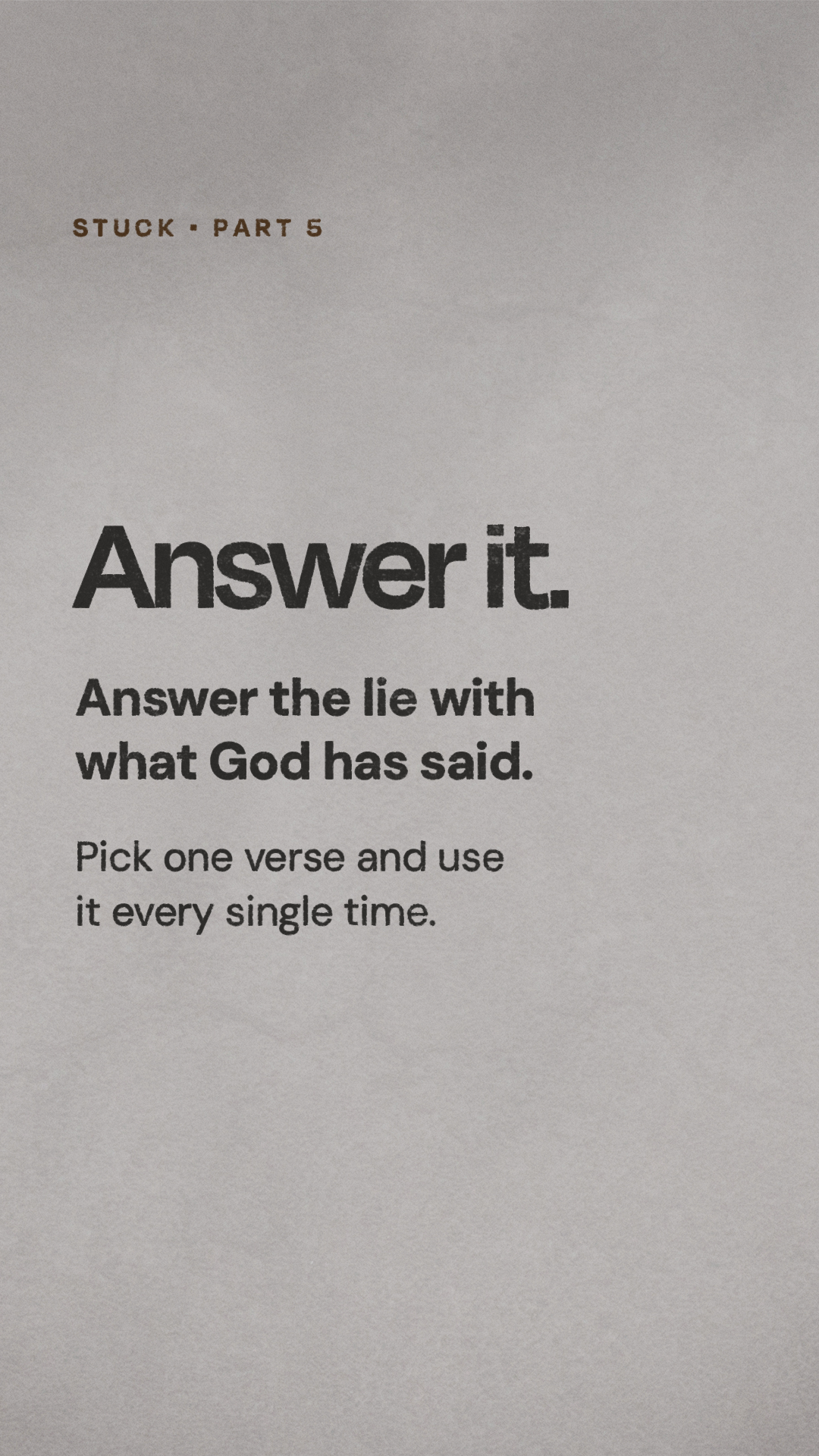
I don’t have notes for you today you just might want to jot these down question it hey when that voice tells you you’ll never be happy again just don’t believe it I mean we believe some of the most ridiculous things that we say to ourselves and then when someone opens the word of God and tells us truth that’s the thing that we honestly want to question we’ve got that so backwards look at the psalmist the psalmist said soul why are you saying this so why are you feeling this way and a lie only has power when nobody questions it so question it question yourself what else you can do answer it answer the lie with what God has said not with what you heard on a podcast not with what your best wisdom comes up with not from something that I say or somebody else says no answer it with what the word of God says God’s truth his light answer it with what God has said pick that verse you might find yourself saying it multiple times so I’m just afraid that I’m gonna be all alone and that God isn’t gonna be there then quote Hebrews 13:5 that he’ll never leave you or abandon you see I just don’t think I can get through this I don’t have the strength and I don’t have the energy to do what’s needed then you might want to quote 2nd Corinthians 12:9 that his grace is sufficient for you you might find yourself so broken that you don’t feel like you can even pray the words that you want to pray and it might be Psalm 34 but the Lord is near the broken hearted and it might be might be some verse that God uses to speak to you to tell you he knows right where you’re at you might find yourself saying some things to you your soul may have a voice but God’s word has the last word and again it’s why we’re supposed to hide his word in our heart.
So question it answer it here’s the last one repeat it that voice doesn’t quit after one try neither did the psalmist three times in one song he said the same words and you have to say the same words over and over again you might find yourself saying the same thing over and over and over listen it was a couple of years of me saying God you’re good God you’re good my problem is is I just can’t see it I pray that I can’t count how many times and every time you finish you find yourself feeling the same you might need to just keep praying hey I’ll still praise him like the psalmist said you don’t have to feel it you’re telling your soul how the story is gonna end.
And some of you here in this message right now it might be easy to think so the Bible is kind of like a self-help book no no self-help tells you the answer is already inside of you and the answer isn’t inside of you the self-help book tells you that if you dig and you ask yourself enough questions that the true answer and real good just lives inside of you and you just got to pull it out.
No scripture tells us God is the answer it is his truth it is his light and so when I preach truth to myself when you preach truth to yourself it’s not manufacturing a feeling it’s standing on the solid truth that is God’s your circumstances might not change at all my circumstances might not change hey God’s word doesn’t change either and that’s what we’re resting on if our hope is in our circumstances getting better and if our hope is in our circumstances changing and somehow our health becoming better what happens when our health doesn’t get better what happens when the circumstances don’t change what happens when things only get more difficult and they never get better we put our hope and our security and our rest in a bunch of changing things that we have no control over rather than putting our hope and our rest in God who’s in control of everything.
So keep saying the truth when you hear your voice question it answer it repeat when you do remember it’s not a means of getting an outcome that you desire it’s trusting the truth God’s word to remind you what is true about him so when there’s nothing that you can do you can still come to God that’s what the psalmist kept doing over and over and over again through his tears through his questions through everything he just kept trusting God and kept leaning in and saying God you’re God you’re there and I need your truth and I need your light.
Some of you this morning you may need to do that you may have been listening to the wrong voice this whole time I know it’s easy to trust you Jeremiah says something about your heart and my heart that it’s so desperately wicked and deceitful that you and I we can’t understand it so maybe you’ve been having some conversation with yourself all week and maybe maybe it’s time for you to take that conversation that worry that concern that desperation that feeling and bring it to the feet of your heavenly father and say I’ve tried I’m afraid I can’t do this on my own and I don’t understand.
You may need to spend time and pray with him you know one of the things I love about God because there’s so much I mean he sent his son for us he redeemed us he saved us he bought us back when we were wandering away in sin but one of the things that I love so I can trust who he is he’s a loving heavenly father so you need to run to him as a father and say Lord in my desperation in my worry and my concern and everything father here I am I need you help me put my hope in you help me put my trust in you