Watch message
What to Believe When You’re Stuck

Share message
Link Copied
Key Scripture
Discussion Questions
Message Highlights
- When you’re stuck, the New Testament keeps coming back to one word: believe. Specifically, believe that God is at work, even when you can’t see it.
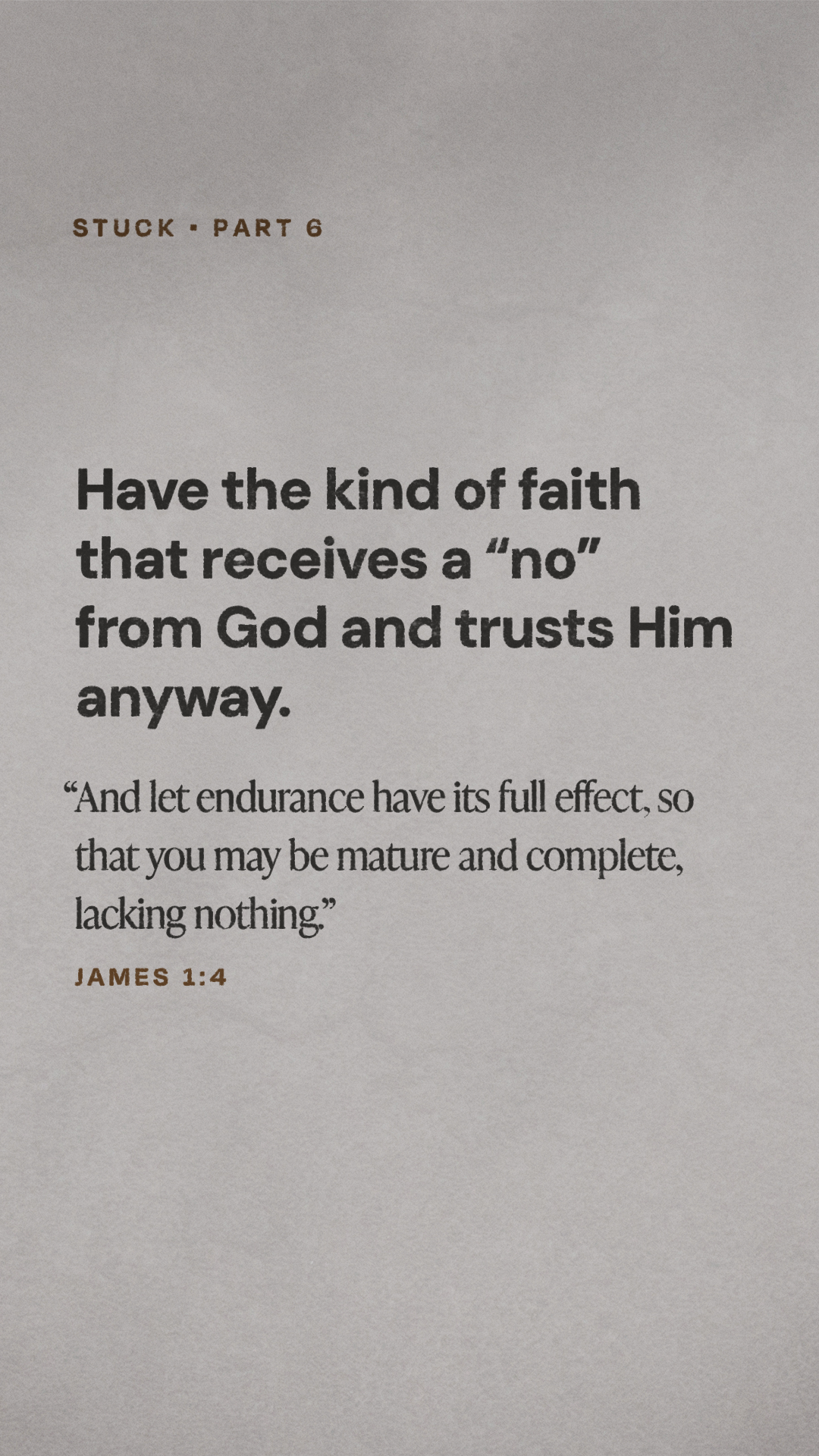
- James tells believers to consider trials a source of something good, because the testing of faith produces endurance. When endurance has its full effect, it makes us mature, and maturity is measured by faith that keeps going, not perfect behavior.
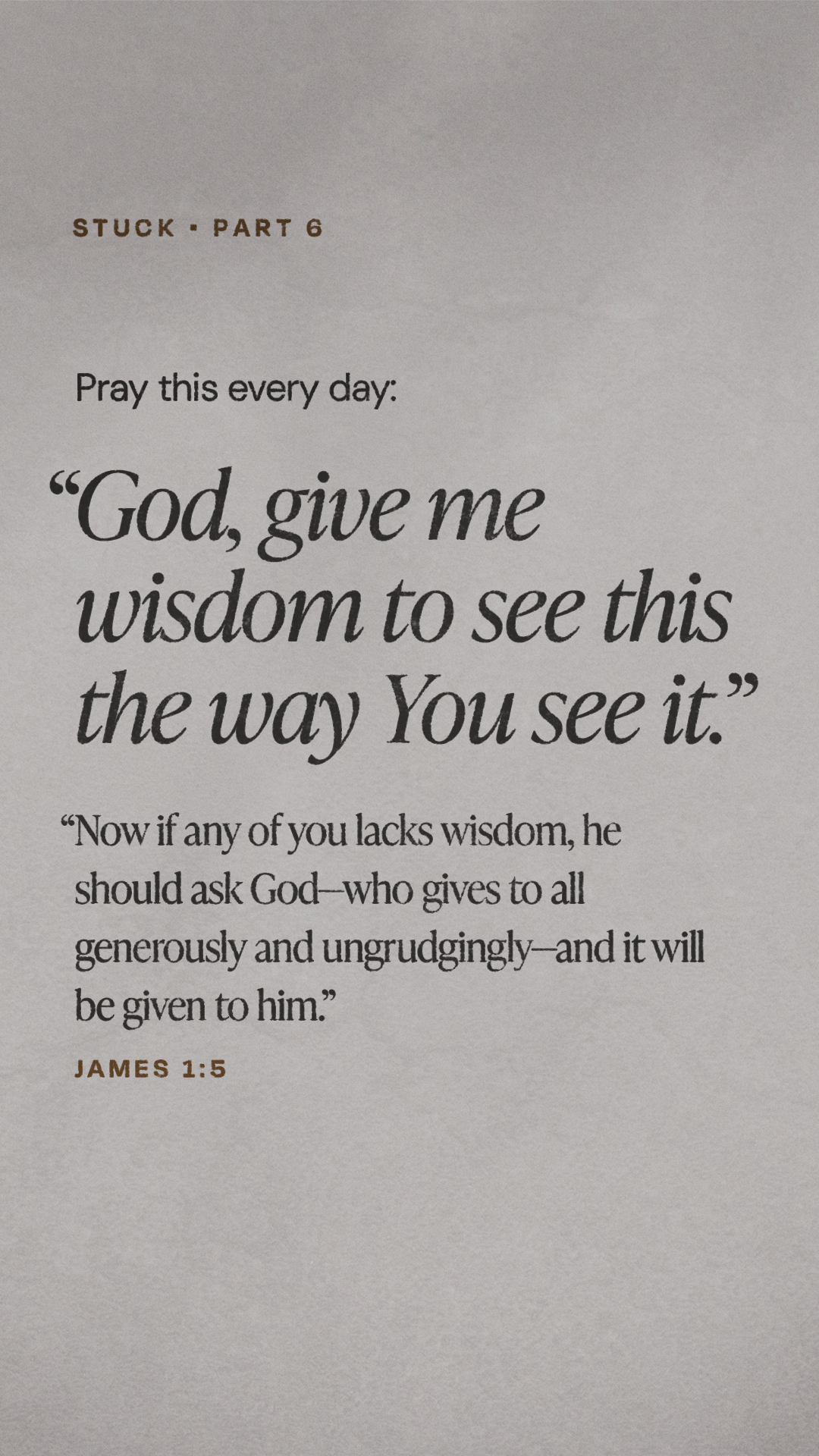
- When you can’t make sense of your situation, ask God for wisdom to see it the way He sees it, and trust that He gives generously.
Conversation Starter
- Think of a time you were literally stuck: traffic, a snowstorm, a long layover. How did you pass the time?
- What’s something you got good at only because you kept at it longer than you wanted to?
Core Discussion Questions
Connection Question: What stood out to you from this week’s message about believing God is at work when you’re stuck?
Context Question: Where have you encountered James 1:2 (“Consider it a great joy… whenever you experience various trials”) before, and what was your understanding of it?
Clarity Question: How did this week’s message clarify or change your perspective on what spiritual maturity looks like?
Application Question: What truth from this week’s message can you apply to a situation in your relationships, work, health, or finances that isn’t changing right now?
Additional Questions (Optional)
- Our faith grows when we keep trusting God in the moments we get a “no” from Him, or He stays silent. Why do you think that kind of faith stands out?
- What makes it hard to trade “Why is this happening to me?” for “What is God building in me?”
- What’s the difference between bringing God honest questions and the “double-minded” doubt James describes?
Personal Study
Exploring the Scripture
Main Scripture: James 1:2–8 (CSB)
The James who wrote this letter is the brother of Jesus (Galatians 1:19). During Jesus’ ministry, he didn’t believe in Him (John 7:5). After the resurrection, Jesus appeared to him (1 Corinthians 15:7), and James became a leader of the church in Jerusalem (Acts 15:13–21; Galatians 2:9). Early historical sources record that he was martyred for his faith around AD 62. He writes as someone who knows what it costs to keep believing.
He addresses the letter to “the twelve tribes dispersed abroad” (James 1:1), Jewish believers scattered beyond Jerusalem. After Stephen was killed, persecution drove many believers out of the city (Acts 8:1; Acts 11:19). James isn’t offering theories about hardship to comfortable people. He’s writing to people already living it, and his letter reads a lot like the Old Testament wisdom books: short and practical.
A few words carry the passage. The word translated “experience” in verse 2 is the same word Jesus uses for the man who “fell into the hands of robbers” (Luke 10:30): trials you don’t see coming. The “testing” in verse 3 is a word used for proving the genuineness of something, like refining metal (1 Peter 1:6–7). In verse 4, “full effect” and “mature” share the same Greek root: let endurance finish its work so that you will be finished, complete. And “double-minded” in verse 8 literally means “two-souled,” a person split between trusting God and trusting something else.
This passage echoes Jesus’ own teaching in Matthew 7:7–11 that God gives wisdom to those who ask. The endurance James calls for follows the pattern of Jesus Himself, who “endured the cross” for the joy set before Him (Hebrews 12:2).
Questions for deeper study:
- Read Romans 5:3–5 and 1 Peter 1:6–7 alongside James 1:2–4. What do all three passages say trials produce? What does each one add?
- James didn’t believe in his brother until after the resurrection. How might his own story shape the way he writes about faith under pressure?
- In verse 5, James describes God as giving “generously and ungrudgingly.” What does that tell you about how God receives your requests? Compare Matthew 7:7–11.
- Read 2 Corinthians 12:7–10. God said no to Paul’s request. What did God give him instead?
- Read Hebrews 12:1–3. How does Jesus’ endurance change the way you see your own?
- James uses “double-minded” again in James 4:8. What does it look like in your life to be split between trusting God and trusting your own understanding of a situation?
Deeper Discussion Questions
- Some people read “consider it a great joy” as a call to pretend you’re happy about pain. Job argued with God, Habakkuk asked “how long,” and many of the psalms are laments. How does that help you tell the difference between the joy James describes and denial?
- A common belief says, “If you had enough faith, God would fix it.” How does James 1 challenge that idea?
- Some read verses 6–7 to mean any doubt disqualifies your prayers. Why is it important to distinguish honest questions from the double-minded doubt James describes?
- When hard things happen, our instinct is to fight them, resist them, or try to change them. What does it look like to let endurance “have its full effect” instead?
- If maturity is measured by persevering faith rather than perfect behavior, does behavior still matter? How do you hold those together?
- The Pharisees kept the rules, but their hearts were far from God (Matthew 15:8). Where are you tempted to measure your faith by what you know or what you avoid?
- God will use what He may not remove. Where have you seen that be true, in your life or someone else’s? Are you going through something that makes it hard to believe right now?
Living It Out
- Write down the situation where you feel most stuck. Next to it, write the question “What is God building in me?” Share one honest answer with someone in your group this week.
- Each morning this week, ask God for wisdom: “God, give me wisdom to see this the way You see it.” Keep a short note of anything He brings to mind, and bring it to your group next time you meet.
- Think of a place at work or at home where you’ve been trying to force a change. This week, before acting, ask God what He’s doing there and what He wants from you in it.
- Who do you know who’s stuck right now? Reach out this week to remind them that God hasn’t abandoned them, and ask how you can pray for them.
Prayer Focus
Maybe something in your life isn’t going to change anytime soon, and you’re tired of asking. Pray that God would build endurance in you while you wait, that He would give you wisdom to see your situation the way He sees it, and that He would keep you trusting Him even when the answer is no. Close by reading James 1:2–5.